Medically reviewed by our in-house trichology committee.
The short answer
Pooled trials do point to a gain in hair density. The same pooled trials describe themselves, in their own conclusions, as heterogeneous, low in quality and skewed by publication bias. Both statements come from the same papers, and holding them together is the honest position.
Then there is the comparison almost nobody puts in front of you: head to head against topical minoxidil, across nine randomized trials and 451 participants, PRP showed no clear advantage on hair density. One of those options is a bottle. The other is a course of in-clinic injections.
None of that makes PRP a scam. It makes it a procedure priced well above what the evidence currently carries, and sold under a name that does not describe what goes into the syringe. The rest of this piece is about that second part, because it is the one you can actually act on.
That FDA clearance is about the centrifuge
If you are reading this in the US, you have probably seen “FDA cleared” on a hair clinic’s PRP page. It is worth knowing exactly what it refers to.
No PRP product is FDA approved for hair loss. What some manufacturers hold is clearance for a blood-processing system — a device for preparing platelet-rich plasma — and those clearances largely came through orthopedic uses. Using that output on a scalp is off-label. As the American Hair Loss Association puts it, clearance of a blood-processing system is not the same thing as FDA approval of PRP for hair loss, so a clinic should not be advertising PRP hair restoration as FDA approved simply because its centrifuge is a cleared device.
Two words, two different meanings, and the gap between them is where the marketing lives. Cleared refers to a machine in a back room. Approved, which would refer to your indication, does not exist here.
The same association notes that microneedling devices have not been cleared for hair loss either, nor for driving PRP into skin. That matters because combination offers are common.
Nobody sets a target concentration
Here is the part that surprised me most when I went looking.
There is a regulatory definition of platelet-rich plasma. Spain’s medicines agency, which took a position on this back in 2013, describes it as a volume of autologous plasma whose platelet concentration exceeds the baseline level — baseline being put at 150,000 to 350,000 per microlitre.
Read how that sentence ends. Exceeds baseline. There is no target above it, no range, no minimum you have to hit before you may call the result PRP. Plasma at 400,000 platelets per microlitre and plasma at 1,500,000 go by the same name and get billed on the same line.
I cannot think of another corner of hair loss care where that would pass. Nobody sells a topical “containing minoxidil, somewhere above zero.” For PRP, that is the state of the vocabulary, and you need to know it before you compare two quotes.
The photograph nobody takes before session one
A practical aside before the evidence, because it applies no matter what you decide.
PRP is judged over months, and it is judged badly. The expected effect, where there is one, is gradual thickening rather than visible regrowth. That is precisely the kind of change the human eye cannot assess on itself: you see yourself daily, your styling shifts, your bathroom light shifts, and six months later you will have an impression rather than a measurement.
That impression costs money. If it is favourable, you will buy a maintenance cycle without knowing whether the first one did anything. If it is unfavourable, you may walk away from something that was working.
The fix is two habits. Dated photographs, taken before the first session, same spot, same light, dry hair, same parting — the full method sits in our piece on tracking loss that never shows up in a number. And if you want something firmer than a phone snapshot, magnification: a cheap USB scalp camera lets you photograph the same few square millimetres before and after, and count. It is the only way you will know whether a four-figure course produced anything at all.
See USB scalp cameras →Affiliate linkWhat matters on one of these: enough magnification to tell fine hairs from thick ones, and some landmark that lets you return to exactly the same spot. A device like this diagnoses nothing. It measures, which is already a lot.
Do it even if you skip PRP entirely. A baseline serves every protocol, including the free ones.
Two machines, opposite results
Now the finding that made me write this.
In 2017, a team published work measuring the growth factor concentrations obtained from different PRP collection systems in people with hair loss, alongside clinical outcomes at six months. After calcium activation, growth factor concentrations did not differ significantly between the devices. The clinical results went in opposite directions: density up with one collection device, down with the other, at six months, in patients treated inside the same study.
Thirty-six people in total, one paper, nearly a decade old. I am not going to turn that into a demonstration, and certainly not into an accusation against a manufacturer — those numbers cannot carry either. What they can carry is a question your quote never raises. If the injected product can vary that much between systems, and nobody can say which preparation parameter decides the outcome, then the word “PRP” on your invoice tells you nothing about what is going into your scalp.
The diagram below walks the preparation chain backwards. Five stages, and at every one a decision that no standard pins down.
Interactive diagram
"PRP" is not the name of a product. It is the name of a five-step chain
Tap a stage to see what varies between clinics at that point — and what never appears on your quote.
Five stages, five decisions made without you. Pick one above.
What the diagram shows
Two clinics can both bill you for "PRP" and inject two different things, with neither of them cutting corners: not one of these five stages is pinned down by a standard. A 2017 paper that compared two collection devices inside a single study is the sharpest illustration of that slack — measured growth factor concentrations did not differ significantly between the two machines, and the six-month clinical results still went in opposite directions. Thirty-six people in total, and a single study: small. But it points at something uncomfortable, which is that nobody can say which part of the preparation decides the outcome.
The correction
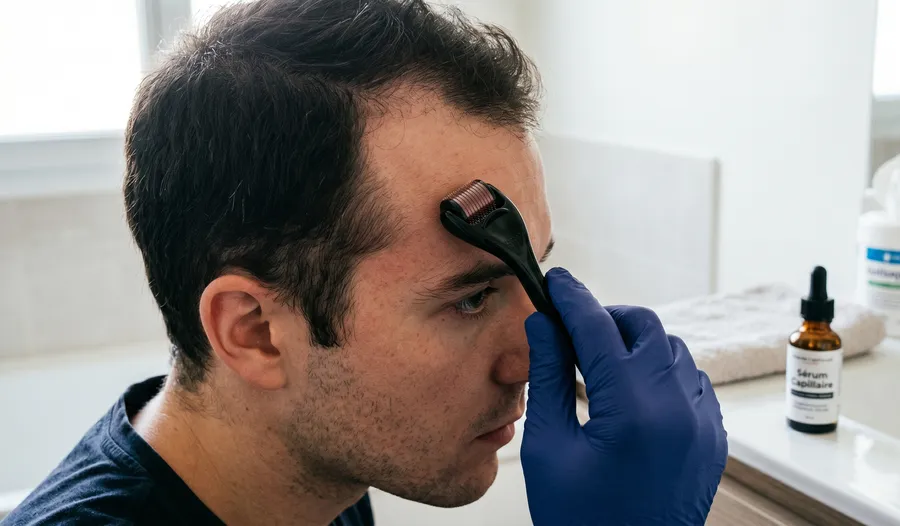
Not "avoid PRP" — stop buying a word. Ask in writing which system is used, how many sessions the price covers and at what interval: a 2023 umbrella review converges on at least three consecutive sessions a month apart, and a one-off "let's try it" session matches nothing that has been studied. Worth knowing too: an FDA clearance in a clinic's marketing usually belongs to the centrifuge, not to your hair. And if what you want is a documented procedure at a fraction of the cost, microneedling has a file — needle sizes, frequency and limits in our dermaroller guide for a receding hairline.
Affiliate link
Check before buying: one-piece surgical steel needles, 0.5 mm for the scalp, and strictly personal use. The protocol and the 24-hour rule with a topical are in the guide above.
One point in the procedure’s favour, in fairness: this variability is not sloppiness on the part of practitioners. It is built into a product made on the spot out of the patient’s own blood. You cannot standardize a person the way you standardize a production line. It is a structural limit rather than negligence — and it will still be there in the most rigorous clinic in your city.
What the meta-analyses say about their own studies
The literature here is larger than people expect. Randomized trials exist, meta-analyses exist, and there are even reviews of reviews. Volume is not the problem.
Take the most explicit of them. A 2024 systematic review and meta-analysis in Anais Brasileiros de Dermatologia concludes that PRP increases hair density in androgenetic alopecia. In the same breath, its authors characterise the studies they pooled: highly heterogeneous, low in quality, and showing evident publication bias. They call for better trials.
That last phrase deserves translating. Publication bias is what happens when trials finding an effect get published while trials finding nothing stay in a drawer. When a meta-analysis flags it in its own dataset, it is telling you that its pooled result is probably flattering. That is a creditable admission, and it is information you should use.
The other useful piece is a 2023 umbrella review in the Journal of Cosmetic Dermatology. Its stated aim gives the game away: to assess PRP’s efficacy and to establish an effective treatment protocol and an optimal preparation procedure. You do not set yourself that task if it has already been done. Thirteen years after the first trials, there was no reference procedure — and it is from this review that the only roughly converging numbers in the whole file come: a volume of at least 0.05 ml per square centimetre, preferably 0.1 ml, and at least three consecutive sessions a month apart.
Those are parameters of a medical procedure and belong in a conversation with the clinician performing it. They are not a dose to demand. But they do give you a yardstick for reading an offer — and they rule out the one-off session sold as a trial.
Against topical minoxidil, no clear advantage
This is the comparison everyone should see before signing, and it is rarely shown.
A meta-analysis published online in late 2025 in Aesthetic Plastic Surgery pooled nine randomized trials and 451 participants to put PRP directly against topical minoxidil in androgenetic alopecia. On hair density, no significant difference. The authors conclude that their work does not demonstrate a clear advantage for PRP over minoxidil, on density, on terminal hair count, or on the proportion of good responders.
A systematic review published a few months earlier in Skin Health and Disease lands in the same place, with the nuance tilting the other way: topical minoxidil showed more improvement in terminal hair count and in the proportion of anagen hairs, with PRP presented as either an alternative or an add-on.
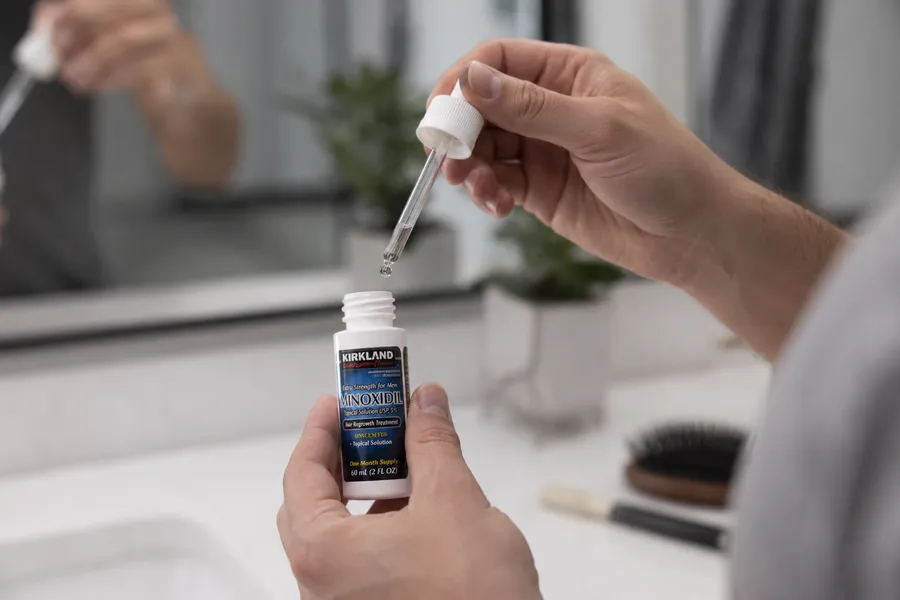
Lay that out. On one side, an in-clinic procedure requiring several sessions, maintenance, and a four-figure sum on most price lists. On the other, a bottle sold without prescription in most countries, whose application protocol we cover in detail. The randomized trials that have compared them do not separate the two on density.
That is not an argument for ruling PRP out. It is an argument for not putting it first — and for distrusting any presentation that calls it superior without producing the comparison.
Two necessary caveats. Topical minoxidil is a drug: it has documented side effects, it is not a trivial product, and it should not be started on the strength of an article. And finasteride, which comes up constantly in these conversations, is prescription-only, with an absolute contraindication in pregnancy. Comparing evidence levels never removes the need for medical advice.
For women, the measured gain was 0.01 mm
A 2024 systematic review and meta-analysis in Skin Research and Technology pooled 21 studies and 628 participants to assess PRP in female hair loss. Its conclusion is positive: PRP improves hair density and thickness, with a favourable safety profile.
Look closer at thickness, since that is what gets quoted. The reported mean difference is 0.01 mm — one hundredth of a millimetre — with very high heterogeneity between studies. On hair count, the two studies reporting it showed no significant difference.
A hundredth of a millimetre is statistically real and visually nonexistent. That is not a criticism of the review, which reports what it found; it is the gap between significant and visible, and it is exactly the nuance that evaporates once a number reaches a sales page.
There is a second problem for a female reader. The pooled trials were not all studying the same condition: most concerned chronic telogen effluvium, with the rest covering androgenetic alopecia or female pattern hair loss. Those differ in cause and in natural course — and telogen effluvium frequently turns around on its own once its trigger is corrected. Blending them into one calculation makes the output hard to read.
Safety, though, is a genuine positive, and it was measured: reported pain and discomfort did not differ from control groups in the studies that recorded them. PRP remains an injection, with everything that implies, but systemic effects are not the charge against it.
Does PRP make sense in your case?
None of the above decides anything for you, because the value of this procedure depends less on the procedure than on what you have and what is being offered. Diffuse shedding that started in September, temples receding for eight years, a smooth patch where nothing grows, and a PRP line tucked into a transplant package are four different questions — and in two of them, the sensible answer is no.
Checker · 3 questions
Does PRP make sense in your case?
Question 1 / 3
What does your hair loss look like?
💡 Reading grid built by Thomas R., hair restoration specialist, from the sources listed at the end of this article. It frames the conversation; it does not diagnose and it does not decide on a medical procedure. PRP is an injection, and a physician is the one who indicates or rules it out.
Five things to settle before you book
If the conversation is still open after all that — and it reasonably can be — here is what I would ask for in writing. None of these questions is hostile. A serious clinic answers them without difficulty, and how it answers tells you as much as the answers themselves.
Which preparation system, by name, and what published data exist on that system. This is the question the device variability makes unavoidable. “PRP” is not an answer.
Is the final platelet concentration verified, or assumed. Since the regulatory definition sets no target, measuring is the only way to know what is being injected. Plenty of clinics do not measure, which is not unlawful — but you are entitled to know.
How many sessions the price covers, at what interval, and what maintenance costs after that. The published landmarks point to at least three consecutive sessions a month apart. The real budget is not the initial course; it is the initial course plus maintenance, over years.
Who performs the injection, and under what written consent. This is a medical procedure that breaks the skin, using an autologous blood product prepared on site.
What baseline will be kept. If the clinic offers no standardised photography before the first session, take it yourself. Without a starting point, the result will be a conversation rather than an assessment.
And one hard line: if you are quoted a regrowth percentage, a guaranteed timeline or any numeric result, the claim is false. The literature cited above supports none of those promises, and a clinic that makes them has told you something useful about itself. The same reflex applies to transplant packages, where PRP is the easiest line to add — the real cost of a transplant and the criteria that separate a serious clinic from a mill are handled separately.
If what you actually want is immediate appearance rather than a long protocol, say so plainly to your doctor: honest camouflage options exist, covered in our piece on hair building fibers, and they make no regrowth claims at all.
Limits, and when to see a doctor
This article diagnoses nothing, prescribes nothing and does not replace an examination. PRP is an injection: its indication, its contraindications and its performance belong to a physician, and nothing above constitutes personal medical advice. Anyone with a clotting disorder, a blood condition, an active scalp infection, or on certain medications is not in the position of the trial participants cited here — that is for the practitioner to weigh.
What warrants medical advice without waiting, and before any spending:
- shedding that is sudden and heavy, in handfuls, or clearly accelerating;
- sharply defined bare patches, particularly if eyebrows, lashes or nails are also affected;
- a smooth, shiny or hardened area with no visible follicular openings, which suggests scarring alopecia — a situation where the PRP rationale does not apply;
- a scalp that is red, sore, scaly or has changed in appearance;
- shedding alongside unusual fatigue, weight changes or cycle changes;
- after an injection: fever, settling pain, spreading redness or discharge. In that case contact the practitioner who performed the procedure, rather than waiting for the next appointment.
On PRP itself, three limits hold together and should be read together. The meta-analyses conclude there is a density gain while describing their own sources as weak. The product is not standardized, and its variability is structural. And against the cheapest topical on the shelf, randomized trials do not give it the edge. None of that makes it a procedure to avoid; all of it makes it a procedure priced, on many lists, well beyond what the evidence supports.
Frequently asked questions
Does PRP regrow hair? Recent meta-analyses conclude that it increases hair density in androgenetic alopecia, while describing the pooled studies as heterogeneous, low in quality and affected by publication bias. So it is more accurate to say there is a positive signal measured on fragile foundations than to say it works. No regrowth percentage can be promised.
How many sessions does it take? The most converging published landmarks come from the 2023 umbrella review: at least three consecutive sessions a month apart. That is a parameter of a medical procedure, decided with the physician — but it lets you judge an offer, and a single session fits no studied schedule.
Does it hurt, and what are the side effects? In the studies that recorded it in women, reported pain and discomfort did not differ from control groups. It remains an injection into the scalp, with the risks that come with any procedure breaking the skin. Contraindications and monitoring are the practitioner’s call.
Is PRP FDA approved for hair? No. No PRP product is approved for a hair loss indication. Certain blood-processing systems hold clearance covering the preparation of plasma, largely for orthopedic use, and scalp use is off-label. A clearance logo on a clinic site generally concerns its equipment, not your indication.
Should it be done before or after a transplant? It is frequently offered alongside a transplant, and literature on that adjunct role exists but remains limited. The practical question is an accounting one before it is a medical one: ask for the package price with and without, and what exactly the difference buys.
Can it be combined with topical minoxidil or microneedling? Work has examined adding PRP to topical minoxidil and reports a benefit, at a level of certainty the authors themselves grade as low. In principle the combination is worth discussing with the physician following your case. On the microneedling side, the protocol and the 24-hour rule matter more than stacking techniques.
How long before I can judge? Not for several months, and only with a baseline. Hair grows roughly a centimetre a month, a full course runs three monthly sessions, and the expected effect is gradual thickening. Verdicts delivered at six weeks measure early hope and nothing else.
Sources and references
- Kieling BA, et al. — Is autologous platelet-rich plasma capable of increasing hair density in patients with androgenic alopecia? A systematic review and meta-analysis of randomized clinical trials. Anais Brasileiros de Dermatologia, 2024;99(6):847–862. DOI 10.1016/j.abd.2024.01.002. Systematic review with meta-analysis of randomized clinical trials. The authors conclude that PRP increases hair density in androgenetic alopecia, while stating that the pooled studies were highly heterogeneous, of low quality and showed evident publication bias, and calling for trials of better methodological quality.
- Li M, Pan Y, Yang X, Kong Y, Zhang B. — An umbrella review of the use of platelet-rich plasma in the treatment of androgenetic alopecia. Journal of Cosmetic Dermatology, 2023. DOI 10.1111/jocd.15617. PMID 36718799. Review of reviews whose stated objective is to evaluate PRP’s efficacy in androgenetic alopecia and to establish a treatment protocol and an optimal preparation procedure, with included work appraised using AMSTAR 2. The authors recommend a volume of at least 0.05 ml/cm², preferably 0.1 ml/cm², and at least three consecutive sessions one month apart. These are the only converging numeric landmarks in this file; they describe a medical procedure and are not a personal recommendation.
- Gentile P, et al. — Evaluation of Not-Activated and Activated PRP in Hair Loss Treatment: Role of Growth Factor and Cytokine Concentrations Obtained by Different Collection Systems. International Journal of Molecular Sciences, 2017;18(2):408. DOI 10.3390/ijms18020408. Two-part work: a clinical comparison of non-activated and calcium-activated preparations, and ELISA measurement of growth factors (PDGF-BB, TGF-β1, IGF-1, VEGF) obtained from different collection systems. Growth factor concentrations did not differ significantly between devices after activation; the authors nonetheless report markedly different six-month clinical outcomes between two collection devices, one associated with a density gain and the other with a loss. Around 36 participants in total, a small sample, with the assays run on a very small number of measurements. The two devices are named in the publication; they are not named here, since a divergence seen in a single study of this size cannot support a judgement on a marketed product.
- Yuan L, et al. — Effectiveness of platelet-rich plasma in treating female hair loss: A systematic review and meta-analysis of randomized controlled trials. Skin Research and Technology, 2024;30(8):e70004. DOI 10.1111/srt.70004. Six databases searched from January 2000 to May 2024; 21 studies and 628 participants included. The authors conclude that PRP improves hair density and thickness in women, with a favourable safety profile. Reported figures: mean difference of 0.01 mm in hair thickness with very high heterogeneity (I² = 97%); no significant difference in hair count across the two studies reporting it; pain and discomfort comparable to controls in three studies (RR = 1.01, 95% CI 0.87–1.18). The included diagnoses are mixed: androgenetic alopecia, chronic telogen effluvium and female pattern hair loss.
- Comparative meta-analysis, PRP versus topical minoxidil — Comparative Efficacy and Safety of Platelet Rich Plasma (PRP) versus Topical Minoxidil for Androgenetic Alopecia: A Systematic Review and Meta-analysis. Aesthetic Plastic Surgery, published online November 2025. DOI 10.1007/s00266-025-05394-7. Nine randomized trials, 451 participants. No significant difference between PRP and topical minoxidil on hair density; the authors conclude that their analysis does not demonstrate a clear advantage of PRP over minoxidil, including on terminal hair count and the proportion of responders. The full author list could not be confirmed from this session, so the reference is given by title, journal and DOI. An anomalous odds ratio appearing in secondary summaries is deliberately not reproduced here.
- Comparative systematic review, PRP and topical minoxidil — Comparison of the efficacy of platelet-rich plasma with topical minoxidil in treating patients with androgenetic alopecia: a systematic review of clinical trials. Skin Health and Disease, 2025;5(5):311. Systematic review of clinical trials. Topical minoxidil showed more improvement in terminal hair count and in the proportion of anagen hairs; PRP’s efficacy is described as comparable, and the procedure presented as either an alternative or an adjunct. Reference given by title, journal, volume and page; the author list could not be confirmed from this session.
- American Hair Loss Association — Platelet-Rich Plasma (PRP) for Hair Loss. Association information page. Points used: no PRP product is FDA approved for a hair loss indication; certain blood-processing systems hold clearance covering the preparation of plasma, chiefly for orthopedic applications, and scalp use remains off-label; clearance of a blood-processing system is not equivalent to FDA approval of PRP for hair loss, so a clinic cannot present the service as FDA approved merely because it uses a cleared device. The same page notes that microneedling devices have not been cleared for hair loss or for delivering PRP into skin.
- Agencia Española de Medicamentos y Productos Sanitarios (AEMPS) — Plasma rico en plaquetas (PRP). Institutional page, resolution of 23 May 2013 establishing non-substitutive therapeutic use of autologous plasma and its fractions, components or derivatives as a medicinal product for human use, with the associated report (material corrections published August 2013). Points used: the definition of PRP as a volume of autologous plasma whose platelet concentration exceeds the baseline level, that baseline being put at 150,000–350,000/μL; the distinction between open and closed collection systems; classification as a non-industrially manufactured medicinal product. Added to this, information note NI-MUH 16/2015 creating a registry of healthcare centres performing this use. The European framework for substances of human origin is changing — Regulation (EU) 2024/1938 applies in the main from 7 August 2027 — and its exact consequences for PRP could not be verified from this session, so they are not asserted here. The agency’s own page governs.
The sources above are cited by journal, year, volume, DOI and PubMed identifier where these exist. Direct access to PubMed, Europe PMC and publisher sites was blocked by this session’s network policy, so each reference was verified by cross-checking several independent searches, and anything drawn from full text is reported at abstract level or phrased qualitatively. A 2024 systematic review in the Journal of Cosmetic Dermatology, widely cited on this topic, was deliberately left out: it was the subject of a 2026 correction notice whose content could not be read. No regrowth percentage, no responder rate and no timeline is advanced here beyond what the cited publications report themselves, and no price is quoted.