Complete medical guide
Male Hair Loss & Baldness
Everything you need to know about androgenetic alopecia in men: causes, diagnosis, medical treatments and surgical solutions. Written and reviewed by our experts.
Written by Thomas R. (Hair Restoration Specialist) · Medically reviewed by our internal dermatological board
One morning, you looked at your reflection differently.
Not a shock. More of a nagging discomfort. A temple that looked just a little too bare, a part that seemed wider than it used to be. You rearranged your hair and told yourself it was the lighting.
It wasn't the lighting.
In the US alone, over 35 million men are affected by androgenetic alopecia — what most people simply call male pattern baldness. One in two will develop a visible form before turning 50. One in four, before 30.
The culprit has a name: DHT. It's a hormone. It has been silently attacking your hair follicles for years — long before the mirror delivers its verdict.
This guide won't sell you miracles or false hope. It gives you what your doctor probably doesn't have time to explain: the exact biology of your hair loss, how to read your own stage on the Norwood scale, and which protocols actually have peer-reviewed evidence behind them.
You've started losing your hair. You are not condemned to keep losing it.
The Biology of Hair Loss
Every square centimetre of your scalp contains between 150 and 200 follicles. Each one is an autonomous unit that follows a biological cycle in three phases.
The anagen phase: active growth. It lasts between 2 and 7 years depending on your genetics. This determines the maximum length your hair can ever reach.
The catagen phase: the transition. 2 to 3 weeks. The follicle retracts and severs its connections.
The telogen phase: rest. Around 3 months. The dead hair stays in place while a new one forms beneath it, then falls out naturally during washing or brushing.
Under normal conditions, 85 to 90% of your follicles are in the anagen phase simultaneously. You naturally shed between 50 and 100 hairs per day. That's physiological. That's not what we're talking about here.
What we're talking about is when the anagen phase progressively shortens — cycle after cycle — until it lasts only a few months. Each new hair regrows thinner, shorter and paler than the last. This is the onset of follicular miniaturization. And behind this mechanism, there is almost always the same molecule.
DHT and androgenic receptors: the root cause
DHT — dihydrotestosterone — is an androgen. Your body produces it from testosterone via an enzyme: 5-alpha-reductase type II, concentrated in hair follicles, the scalp and the prostate.
The conversion is straightforward: Testosterone → 5-alpha-reductase enzyme → DHT. DHT is approximately 5 times more potent than testosterone at binding to the androgenic receptors (AR) in follicular cells. Once bound, it sends a clear signal: shorten your cycle, shrink.
But here's the critical point — one that most people miss: it's not the amount of DHT that varies between men. It's the sensitivity of their androgenic receptors. Two men with identical testosterone levels can have radically different degrees of baldness. The difference lies in the genetic expression of the AR gene (X chromosome, inherited from the mother) — and in more than 280 other genetic loci identified to date.
💡 Expert Advice from Thomas R. — Hair Restoration Specialist
"In consultations, I often see 25-year-olds in a panic because they're shedding 80 hairs a day. And others at 35 losing 200 hairs a day who barely notice. Quantitative shedding is rarely the real warning sign. What matters is the thinning of the shaft diameter on regrown hairs. Check your temples in natural daylight. If the hairs coming back are finer and lighter than the rest of your scalp, you are dealing with active miniaturization. Act now."
Follicular miniaturization: cycle after cycle
Miniaturization doesn't happen overnight. It's a staircase process that unfolds over years — sometimes decades.
- Cycle 1: terminal hair. Pigmented, thick, ~0.07 mm in diameter.
- Cycles 5 to 10: intermediate hair. Shorter, slightly finer.
- Cycles 15 to 30: vellus hair. Downy, nearly invisible. The area appears "bare".
- Final stage: the follicle undergoes fibrosis. Without intervention, the treatment window closes.
A miniaturized follicle can be reactivated. A fibrosed follicle cannot. You have time to act — provided you recognize the warning signs rather than dismissing them.
The first signals to watch for:
- Hair thinning at the crown (the "see-through" look in sunlight)
- Temples receding and becoming asymmetrical
- Your part visibly widening over time
- Brittle, limp hair with no body in the frontal zone
💡 Expert Advice from Thomas R.
"I always ask my patients the same question: 'Do you have photos of yourself from two years ago?' Comparing photos in the same light — hair wet, combed straight back — is the simplest way to quantify progression. The human brain compensates; it adapts to what it sees every morning. Photographs don't lie."
Genetic and hereditary factors
Baldness is inherited from both sides of the family. The AR gene (androgenic receptor) on the X chromosome comes from your mother — but your father and his father give you a strong indication of your trajectory. If both sides are affected, your probability is significantly higher.
To address the root cause, two approaches are clinically validated:
- Block the 5-alpha-reductase enzyme — the mechanism behind DHT blockers like Finasteride and Dutasteride (prescription only). Less enzyme = less DHT = follicles less exposed.
- Reduce local DHT — via 2% ketoconazole shampoo, saw palmetto or copper peptides. No systemic side effects, but less powerful than prescription DHT blockers.
We detail every treatment in Chapter 3. Keep this principle in mind: targeting DHT before fibrosis means protecting the follicular capital that's still active.
Ketoconazole 2% Shampoo
The only shampoo with published clinical data supporting local DHT reduction and decreased shedding. Mechanism similar to Finasteride — without systemic effects.
- 2–3 applications/week, 5 min contact time
- Reduces local DHT on the scalp
- Compatible with Minoxidil & Finasteride
- Visible effect from 8–12 weeks
From $14.90
View Recommended Formula on AmazonAffiliate link — Indicative prices, verified 21/05/26
The Norwood Scale: Assess Your Stage
Your baldness stage isn't just aesthetic information. It's a clinical decision tool. A man at Stage II doesn't have the same options as a man at Stage VI. Medical treatments are more effective early. A hair transplant is only relevant from a certain stage onwards.
The Hamilton-Norwood scale (1975, revised 2012) is the international reference classification. It describes 7 main stages, plus variants. Here's how to read yours.
Stages I to III: the therapeutic window
Stage I — The baseline: scalp intact. No visible recession. This is your reference point — or your father's at your age, if you lack photos.
Stage II — The first signal: slight recession at the temples. A receding hairline is just beginning to take shape. Most men only realize this when they look at photos from a year earlier.
Stage III — The golden window: visible, deep temple recession with a clearly retreating hairline. This is often where men seek help for the first time. And this is where medication makes the most dramatic difference. Don't miss this window.
Stage III Vertex variant: moderate frontal recession, but hair thinning at the crown appearing at the top of the scalp. Common in men aged 25 to 35.
How to assess your stage in 3 minutes:
- "Wet hair" photo: comb straight back without blow-drying, photograph from above in natural light. Miniaturized zones appear clearly — scalp is visible where it shouldn't be.
- Side profile photo: compare your temples to a photo from 1 to 2 years ago. More than a centimetre of recession = active phase.
- Two-mirror test: hold a hand mirror above your head, look into a larger mirror. A faint bare patch at the crown — even slight — signals Stage III Vertex or above.
💡 Expert Advice from Thomas R.
"I see many patients who tell me they've been at Stage II for five years. In reality, when I look at their photos, they've reached Stage IV without realising it. Androgenetic alopecia is insidious: it progresses in subtle steps, then leaps forward during periods of stress or hormonal change. Set a benchmark photo — wet hair, same light, same angle — on the same day every year. It's your personal barometer."
Stages IV to V: moderate alopecia
Stage IV — Moderate alopecia: heavily marked temple recession AND an actively thinning crown. Both zones are progressing but are not yet connected. The remaining hair crown is still dense. A hair transplant starts to become a serious option to consider.
Stage V — The bridge forms: the band of hair between the frontal zone and the crown thins considerably. The two bald zones are converging. Overall density is decreasing.
From this stage onward, the combination of medication and a hair transplant must be seriously evaluated. Medication alone can slow progression but will not fill zones that are already fibrosed.
Stages VI and VII: advanced alopecia
Stage VI — The junction: the two zones (frontal and crown) meet. A large expanse of scalp is visible from the hairline to the vertex. The lateral and posterior hair crown is still present but reduced.
Stage VII — Advanced alopecia: only a horseshoe of hair remains on the sides and back — the "donor area". These follicles are genetically resistant to DHT. The effectiveness of medication on bald zones is very limited at this stage.
| Norwood Stage | Medication | Transplant | Priority |
|---|---|---|---|
| I–II | Optional | No | Monitoring + prevention |
| III–III Vertex | Recommended | No (except specific cases) | Optimal window |
| IV–V | Recommended | As a complement | Combined medication + transplant |
| VI–VII | Limited efficacy | Yes, if donor area is adequate | Surgical evaluation |
FUE or DHI transplants don't treat baldness — they redistribute DHT-resistant follicles. Without concurrent medication, native ungrafted follicles continue to miniaturize.
Clinic selection criteria, FUE vs DHI comparison, key questions for your consultation and post-op follow-up.
Evidence-Based Medical Treatments
Before discussing specific products, one fundamental principle: no hair treatment "regenerates" already-fibrosed follicles. Their role is to slow miniaturization on follicles that are still active and to extend the anagen phase. The earlier you start, the larger the surface area you can protect.
Minoxidil and Finasteride are the only two molecules with FDA approval for male androgenetic alopecia. PRP, Dutasteride, oral Minoxidil and micro-needling show promising data — this chapter presents all of them, honestly.
Minoxidil topical and oral: mechanism and protocol
Minoxidil is a vasodilator discovered by accident in the 1980s. It opens potassium channels in follicular cells, increases local blood flow and extends the anagen phase.
Minoxidil 5% vs 2%: 5% is the male standard. Superior efficacy with no significant difference in side effects. The foam formulation (propylene glycol-free) is better tolerated on an irritated scalp.
Low-dose oral Minoxidil (2.5 mg/day): Used off-label since 2019, with results published in the Journal of the American Academy of Dermatology. Systemic efficacy is superior for certain profiles. Requires medical supervision (blood pressure and heart rate monitoring).
The initial shedding phase — the stumbling block for 40% of users: in the first 4 to 8 weeks, accelerated hair loss is almost universal. This is not treatment failure. Follicles in telogen simultaneously enter catagen, driven by the new anagen cycle triggered by Minoxidil. Give it 3 months before drawing any conclusions.
- Visible results: 4 to 6 months minimum
- Peak efficacy: 12 to 18 months of continuous treatment
- Stopping treatment: return to baseline within 3 to 6 months
💡 Expert Advice from Thomas R. — Hair Restoration Specialist
"I frequently switch patients who've tried topical Minoxidil for 6 months without results to the oral form. Some scalps have poor percutaneous absorption — changing the delivery method can unlock a response that the topical route simply wasn't achieving. The non-negotiable prerequisite: a cardiovascular check-up before starting, and a follow-up at 3 months. Do not self-medicate with this formulation."
Minoxidil 5% Foam — Kirkland Signature
The most studied formula for androgenetic alopecia in men. Same active ingredient as Rogaine, at the best price-to-performance ratio on the market.
- 2 applications/day, morning and evening
- Propylene glycol-free foam formula
- Compatible with dermaroller (48h gap)
- 6-month supply available in one order
From $19.90
View Recommended Formula on AmazonAffiliate link — Indicative prices, verified 21/05/26
Finasteride 1 mg: real-world efficacy and side effects
Finasteride 1 mg is a selective 5-alpha-reductase type II inhibitor. It reduces DHT production by 60 to 70% in the scalp and serum — without affecting free testosterone.
Clinical trial data (Merck study, n = 1,553):
- 3 months: perceptible reduction in shedding for 60% of users
- 6 months: stable or improved density in 80% of patients
- 12 months: visible regrowth for 66%
- 24 months: 15 to 18% improvement in crown density
Dutasteride (0.5 mg) inhibits both isoforms of 5-alpha-reductase (type I and II), reducing DHT by 90%. More potent, with a comparable side-effect profile. Used off-label for hair loss. Recommended monitoring: baseline PSA before age 40, total testosterone at 6 months.
💡 Expert Advice from Thomas R. — Hair Restoration Specialist
"I have to address Post-Finasteride Syndrome because my patients have read terrifying things about it on forums. The clinical reality: sexual side effects (decreased libido, erectile dysfunction) affect 1.4 to 3.8% of patients in randomised placebo-controlled trials — roughly 2 to 4 times the placebo group rate, which illustrates just how significant the nocebo effect is. In my practice, across more than 200 patients on Finasteride, I've had 4 discontinuations due to side effects — in 3 out of 4 cases, symptoms resolved on stopping. This is a serious drug that requires proper monitoring, not a game of Russian roulette. Take it with physician oversight, not from an overseas website."
Emerging treatments: PRP, micro-needling and combination protocols
PRP (Platelet-Rich Plasma): your own blood, centrifuged and re-injected into the scalp. Growth factors (PDGF, EGF, IGF-1) stimulate follicular cell proliferation. Level of evidence: moderate. Meta-analyses from 2021–2023 show a statistically significant improvement in hair density. Protocol: 3 to 4 sessions at 4–6 week intervals, then a maintenance session every 6 months. Average cost: $400 to $800 per session in the US.
Micro-needling (Dermaroller 1.5 mm): micro-perforations trigger a local repair response that amplifies Minoxidil absorption and stimulates follicular growth factors (via the Wnt/β-catenin pathway). The Dhurat et al. study (2013, Journal of Cutaneous and Aesthetic Surgery) demonstrated 3 times greater efficacy for the Minoxidil + micro-needling combination versus Minoxidil alone.
- Recommended frequency: once per week at 1.5 mm depth
- Apply Minoxidil 24 hours after micro-needling — never immediately (risk of excessive systemic absorption)
- Disinfect the dermaroller with 70% alcohol before and after each use
- Replace needles every 6 to 8 months (or after 20 uses)
Titanium Dermaroller 1.5 mm
Micro-needling improves Minoxidil penetration by 75% and stimulates VEGF and Wnt growth factors. Apply Minoxidil 24 hours after each session.
- Titanium needles: precision & long-term durability
- Recommended: once per week maximum
- Target zones: crown and receding temples
- Disinfect with 70% alcohol before/after each use
From $12.90
View Recommended Formula on AmazonAffiliate link — Indicative prices, verified 21/05/26
Hair Surgery & Transplant
A miniaturized follicle can be saved. A fibrosed one will not regrow. From Norwood Stage IV–V, there are areas where no medication will produce visible density. This is where hair surgery comes in — not as a last resort, but as a strategic decision.
A transplant does not treat baldness. It redistributes DHT-resistant follicles from the occipital donor area to the recipient zones. These grafts retain their genetic properties for life — this is the principle of donor dominance (Orentreich, 1959). This chapter has one goal: to help you walk into a consultation with the right questions, and to make sure you don't get taken advantage of.
Sapphire FUE vs DHI (Choi implanter): an unfiltered comparison
Sapphire FUE (Follicular Unit Extraction): individual follicular units are extracted one by one using a circular punch of 0.7 to 0.9 mm. The grafts are then implanted into incisions made with a sapphire blade (more precise and less traumatic than steel). No linear scar. Recovery: 7 to 10 days.
DHI (Direct Hair Implantation) with Choi implanter: the graft is loaded directly into the implanter and inserted without a pre-made incision. Millimetric control over angle, direction and depth. More natural-looking result at high density. Ideal for the frontal zone and temples.
| Criterion | Sapphire FUE | DHI Choi |
|---|---|---|
| Shaving of recipient area | Required | Optional |
| Max density / cm² | 45–55 grafts | 60–80 grafts |
| Natural appearance | Good | Excellent (angular control) |
| Ideal candidate | Large surface area (Stages V–VI) | High density (Stages III–IV) |
💡 Expert Advice from Thomas R. — Hair Restoration Specialist
"I've had patients come back from Istanbul with excellent results — and others with poorly designed hairlines and visibly artificial implantation angles. The technique (FUE or DHI) is not the number one factor. It's the surgeon's skill at designing a natural receding hairline and managing the donor area for future sessions. Always ask to see before-and-after photos of patients with your exact Norwood stage and hair type."
Candidacy criteria and realistic expectations
Not everyone is a transplant candidate. These criteria are not arbitrary — they determine the quality of the result at 5 and 10 years post-op.
- Norwood stage: relevant from Stage III Vertex or IV. Below that, medication outperforms surgery. Above Stage VI–VII, the surface to cover may exceed the donor area management capacity.
- Donor area density: minimum 40 follicular units/cm². A trichogram or dermoscopy is essential before any surgical decision.
- Stability of hair loss: stable shedding for at least 12 months. Transplanting onto progressive baldness is like building on quicksand.
- Age: theoretical minimum of 21, recommended 27–30. Before 25, the baldness pattern is rarely stabilized.
💡 Expert Advice from Thomas R. — Hair Restoration Specialist
"In nearly every disappointing case I review, the transplant was done too early — before stabilization, on a Stage III that was progressing rapidly. Three years later, the baldness had progressed all around the grafts. The patient was left with a dense tuft in the middle of a very sparse zone. A natural result is planned over 20 years, not 2. Stabilize the loss first — ideally 6 to 12 months on Finasteride or Minoxidil — before even considering surgery."
Costs, destinations and choosing a trustworthy clinic
Real price ranges in 2024:
- United States / United Kingdom: $8,000 to $20,000 / £6,000 to £15,000 depending on graft count and technique. Zero insurance coverage for cosmetic procedures. Key advantage: streamlined local medical follow-up.
- Hair transplant Turkey (Istanbul, Ankara): $1,500 to $3,500 "all-inclusive" (hotel, transfers). The quality-to-price ratio can be excellent — or catastrophic. The market is extremely heterogeneous.
- Spain (Madrid, Barcelona): $3,500 to $9,000. A solid compromise: European medical standards, easier follow-up, competitive pricing.
A competent surgeon extracts a maximum of 3,000 to 5,000 grafts per session to protect the donor area long-term. Be wary of any promise of "unlimited grafts".
Red flags to identify before signing anything:
- No pre-op consultation with the actual surgeon (only sales staff)
- A guaranteed density figure quoted in advance
- Procedure performed by non-physician technicians
- No before-and-after photos of patients with your Norwood stage and hair type
- Total price under $1,500 for more than 2,500 grafts
Istanbul vs Ankara clinic comparison, detailed selection criteria, patient testimonials and complete post-operative follow-up protocol.
FAQ — Frequently Asked Questions
Are Finasteride's side effects really that dangerous?
It's the question 9 out of 10 patients ask before starting. The clinical reality: sexual side effects (decreased libido, erectile dysfunction) affect 1.4 to 3.8% of patients in randomised placebo-controlled trials — roughly 2 to 4 times the placebo group rate, which illustrates the powerful nocebo effect at play. In the vast majority of documented cases, these effects resolve on stopping the drug. Post-Finasteride Syndrome is real but rare (estimated prevalence below 0.5% in prospective cohort studies). The recommendation: start with a baseline hormonal panel, work with a physician who genuinely knows the molecule, and stay off forums — their selection bias is extreme (people post when things go wrong, rarely when they go right).
Does wearing a cap every day speed up hair loss?
No. Androgenetic alopecia is determined by the genetic sensitivity of your follicles to DHT — not by mechanical pressure from headwear. A normally worn hat or cap does not compromise scalp blood flow or follicular survival. Important nuance: prolonged wear of a very tight accessory can cause localized traction alopecia (rare, reversible) — a distinct mechanism from pattern baldness. In practice: wear your cap. It's not your problem.
What is the ideal age for a hair transplant?
There is no universal age — only criteria to meet. The recommended minimum is 25–27, ideally 30 and above. Before that, the baldness pattern is rarely stabilized: a transplant performed at 23 may look excellent at 25 and incoherent at 35 if the baldness has progressed around the grafts. The true eligibility condition isn't chronological age but stability — shedding stable for at least 12 months, ideally while on medical treatment for 6 to 12 months. The 30–45 window offers the best combination of a clear baldness pattern and available donor capital.
Can you combine Minoxidil and micro-needling on the same day?
Yes — and the combination is clinically superior to either treatment alone. The Dhurat et al. study (2013, Journal of Cutaneous and Aesthetic Surgery) showed 3 times greater density improvement with Minoxidil 5% + Dermaroller 1.5mm versus Minoxidil alone. Recommended protocol: perform micro-needling first, wait 24 hours, then apply Minoxidil. The micro-channels increase percutaneous Minoxidil penetration, and the inflammatory response stimulates follicular growth factors via the Wnt/β-catenin pathway. Absolute contraindication: never apply Minoxidil immediately after micro-needling if the scalp is in an actively inflamed state — risk of excessive systemic absorption.
My crown is thinning after a first transplant — what should I do?
Distinguish between two scenarios. Post-operative shock loss: shedding of native hairs frequently occurs in the 4 to 8 weeks following a transplant, caused by surgical trauma. It is almost always temporary — healthy native follicles regrow within 3 to 4 months. Progressive post-transplant thinning: if the crown thins 12 or more months after the procedure, it is most likely the natural progression of androgenetic alopecia on ungrafted native follicles. The transplant does not stop baldness. Protocol: verify stability under medical treatment, have a surgeon assess the residual donor area, then discuss a second session — not before 18 months post-op.
Scientific Sources & References
- Kaufman KD, et al. (1998). Finasteride in the treatment of men with androgenetic alopecia. J Am Acad Dermatol. 1998;39(4):578-589.
- Olsen EA, et al. (2002). A randomized clinical trial of 5% topical minoxidil versus 2% topical minoxidil and placebo in the treatment of androgenetic alopecia in men. J Am Acad Dermatol. 2002;47(3):377-385.
- Dhurat R, et al. (2013). A randomized evaluator blinded study of effect of microneedling in androgenetic alopecia: a pilot study. Int J Trichology. 2013;5(1):6-11.
- Adil A, Godwin M. (2017). The effectiveness of treatments for androgenetic alopecia: A systematic review and meta-analysis. J Am Acad Dermatol. 2017;77(1):136-141.
- Gupta AK, et al. (2019). Platelet-rich plasma as a treatment for androgenetic alopecia. Dermatol Surg. 2019;45(10):1262-1273.
Discover your personalised protocol
Answer 4 questions and download your tailored plan.
Our specialist men's guides
Dive deeper with our medically validated articles.

Does Wearing a Hat Cause Baldness? Myth vs Reality
Does wearing a hat cause baldness? A specialist debunks the scalp-suffocation myth, the only real risk (friction alopecia) and how to wear a hat safely.
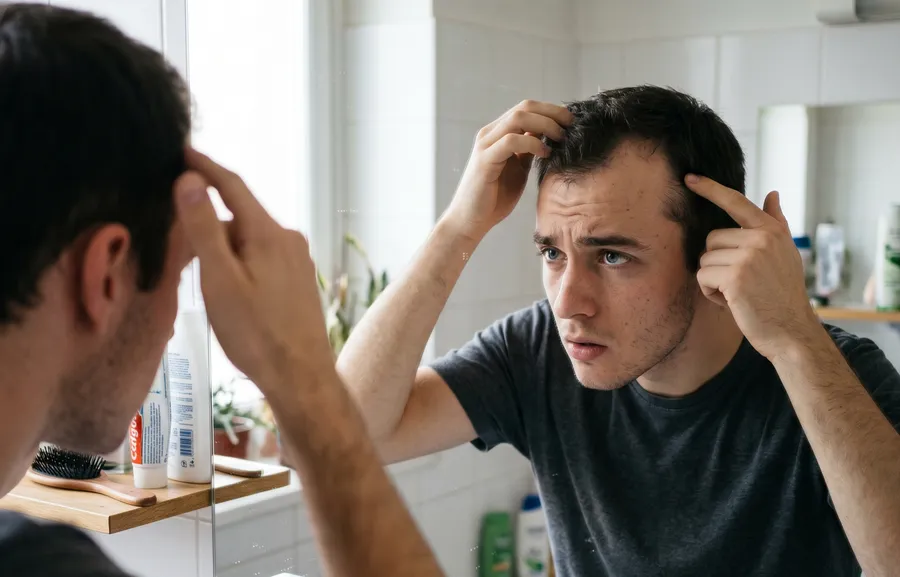
Balding in Your 20s: 5 Early Signs & How to Stop It
Losing hair in your 20s? Before you panic: learn to tell real baldness from a temporary shed. Expert guidance, self-tests, and a proven first-line routine. Acting now changes everything.

Male Pattern Baldness at 30: Normal or a Red Flag?
Losing hair at 30? Thomas R. breaks down the DHT-cortisol link, the rosemary + castor oil kit and when to escalate to minoxidil. Your 30s action guide — no fluff.
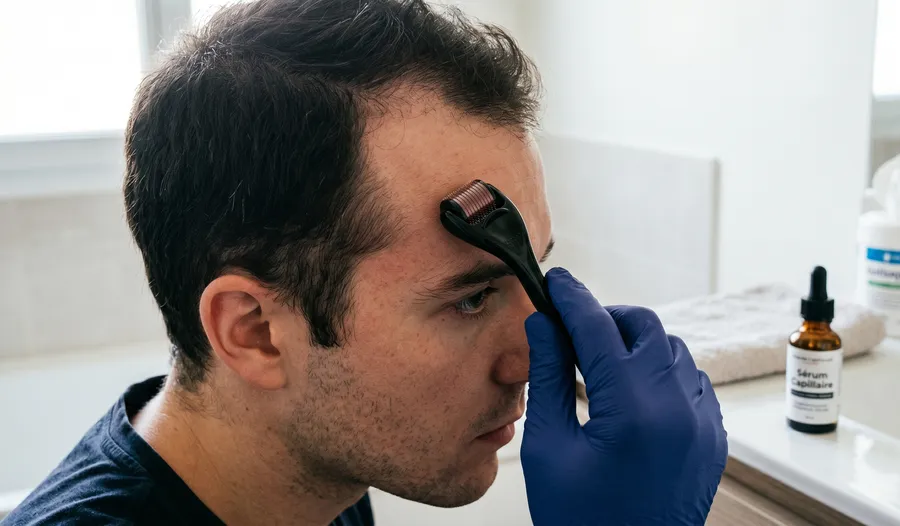
Which Dermaroller for a Receding Hairline? (Sizes, Frequency & Common Mistakes)
Hairline thinning at the temples? Learn the right needle size (0.5mm vs Derma Stamp), the exact home microneedling protocol, and the mistakes that silently kill your progress.