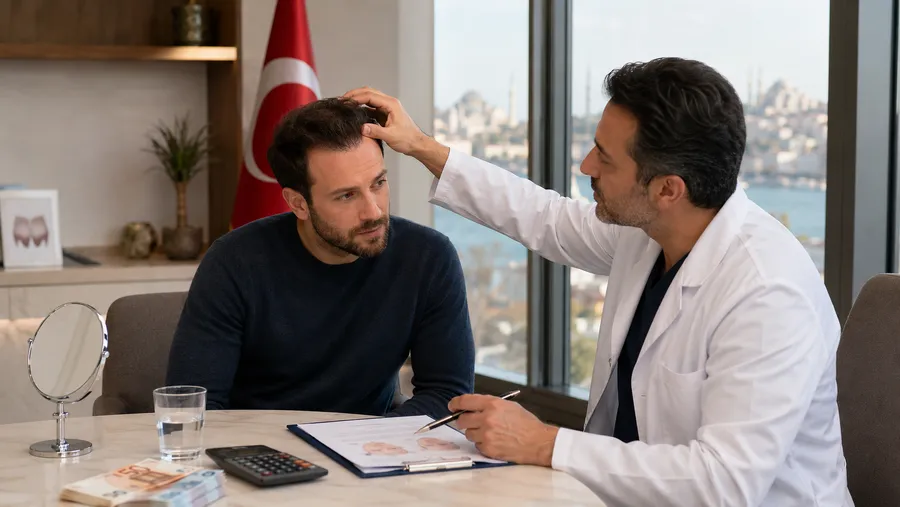
Medically reviewed by our internal hair restoration expert board.
The $1,999 All-Inclusive Instagram Package Is a Pricing Trick
You’ve seen it. Probably multiple times this week. An Instagram reel, a slightly over-saturated before/after, bold white text: “Hair Transplant Istanbul · 3,000 Grafts · $1,999 All-Inclusive ✈️🏨”. Underneath, hundreds of comments — “just got back, totally worth it!” — posted by accounts created three weeks ago.
Here’s what the ad doesn’t show.
“All-inclusive” typically means: the surgical procedure, an airport transfer, two hotel nights, and a small bottle of post-op shampoo. What the package systematically excludes — and what you discover only when you’re actually booking — is the round-trip flight from New York, London or Chicago (anywhere from $400 to $1,200 depending on the season), any extra hotel nights if you don’t live next to a major hub with direct flights, and above all the six months of post-operative treatments that any serious surgeon will prescribe: finasteride, minoxidil, zinc and biotin supplements. Add $150–$220 to your total.
Run the numbers and a package advertised at $1,999 routinely climbs to $2,900–$3,500 in real, out-of-pocket spend. That’s not a scam in the legal sense — it’s a loss-leader price engineered to trigger an impulse booking. And it works extremely well.
💡 Thomas R.’s Warning (Hair Mills): “The problem isn’t the headline price. It’s that the clinics running this volume at this rate are processing four to six patients per room per day. The incisions are made by uncertified technicians while the junior surgeon rotates between operating theaters. I’ve been sent photos of donor areas from some of these procedures — mosaic scarring, completely stripped zones that will never regrow. None of that makes it into the Instagram reel.”
That’s exactly why we built the calculator below and wrote this guide: to give you the real numbers, not the ones on a marketing spreadsheet.
What Do 3,000 Grafts Actually Cover?
Before we talk money, we need to talk anatomy. Because 3,000 grafts do not cover your entire scalp — and saying so openly already puts us ahead of most medical tourism sites.
The Norwood Scale: Your Reference Point
The Norwood-Hamilton scale classifies male pattern baldness from Stage I (no visible loss) to Stage VII (only a horseshoe fringe remains at the sides and back). Here’s what 3,000 grafts can realistically address at each stage:
| Norwood Stage | Affected Area | Are 3,000 Grafts Enough? |
|---|---|---|
| I – II | Slight frontal recession | ✅ Yes, with satisfying density |
| III – III Vertex | Hairline + early crown thinning | ✅ Yes, natural-looking result |
| IV | Hairline + anterior third | ⚠️ Partial — hairline restored, crown untouched |
| V | Advanced frontal + crown loss | ❌ No — two sessions required |
| VI – VII | Extensive loss across the top | ❌ No — 5,000–7,000+ grafts minimum |
In practice, 3,000 grafts are ideally matched to a Norwood III or IV: you rebuild the hairline and restore density in the front third — but the crown typically remains untreated in a single session. If a surgeon promises to cover a Norwood VI in one day with 3,000 grafts, walk away.
Grafts Are Not the Same as Hairs
A single follicular unit graft contains an average of 2 to 3 hairs. So 3,000 grafts ≈ 6,000 to 9,000 implanted hairs. Impressive on paper — but natural scalp density runs around 80–100 follicles per cm². To achieve a perceived natural density, surgeons target roughly 40–55 grafts/cm² in the frontal zone. Anything below that will look thin under raking light.
A standard frontal hairline zone covers about 55–65 cm². That’s 2,200 to 3,575 grafts just for that one area. You can see immediately that 3,000 grafts is a precise surgical budget, not a round marketing number.
The Donor Area: The Silent Constraint
Your donor area — the occipital and temporal crown — is not an unlimited resource. The average person has roughly 6,000 to 8,000 extractable grafts over a lifetime. If you’re 27 with a Norwood IV still progressing, using 3,000 grafts now leaves you 3,000 to 5,000 for a potential second session a decade from now — but only if the donor area was handled conservatively.
💡 Thomas R.’s Warning (Hair Mills): “Budget clinics systematically over-harvest the donor area. They extract in a dense mosaic pattern to maximize graft count in minimum time. The result: a donor area that looks patchy even when shaved, and virtually nothing left for a second session. The best surgeons in Istanbul — the ones who perform every incision themselves — map the donor zone before the procedure and set a hard extraction cap. That’s the difference between a craftsman and an assembly line.”
If you’re at the first signs of hair loss and considering an early transplant, read that guide first. Knowing your exact Norwood stage before you contact any clinic will dramatically change the quality of the consultation you receive.
Real Budget Calculator
Now that you know what 3,000 grafts realistically covers, here’s the tool we wish had existed before our first Istanbul trip. Adjust the sliders for your situation — the total updates in real time.
Real Budget Calculator · Istanbul 3,000 Grafts
Estimate the true all-in cost of your medical trip — hidden fees included.
Estimated Total Real Budget
$3,000
Clinic $2,500 · Flights $500
💡 Simulation based on actual field costs verified by Thomas R.
What the calculator almost always reveals: the clinic fee represents just 70–80% of your real total. The remaining 20–30% — flights, a companion, treatments — gets systematically omitted from forum comparisons and travel-agency quotes. Keep that figure in mind every time you read “all-in from $2,200” on a medical tourism website.
Hair Mills vs Expert Surgeons in Istanbul
Istanbul is home to over 350 hair transplant clinics. That concentration is both its greatest strength — competition keeps prices honest — and its biggest danger. Here’s how to tell the difference between a serious facility and a hair mill.
5 Red Flags of a Budget Clinic
- Your quote arrives via WhatsApp in under five minutes, without any photo of your scalp or video consultation with the surgeon. No competent surgeon can estimate graft count without examining your donor density.
- They offer you 4,000, 5,000, or 6,000 grafts as though it’s a selling point. The more grafts they promise, the more over-harvesting is baked into the plan.
- The contract names “the medical team” without identifying the operating surgeon. In practice, unlicensed technicians perform the extractions and implantations while a junior doctor circulates between rooms.
- The clinic runs 5 to 8 patients per day in the same operating theaters. A proper 3,000-graft session takes 6–8 hours of sustained, focused work. Do the math.
- There is no structured post-operative follow-up beyond a PDF sent on discharge. Leading clinics schedule video check-ins at Day 7, Day 30, and Month 3 to monitor regrowth and catch complications early.
Sapphire FUE vs DHI at Istanbul’s Top Clinics
Both techniques are available at serious Istanbul clinics — and contrary to what the advertising implies, DHI is not automatically superior to Sapphire FUE.
- Sapphire FUE: Incisions are made with a sapphire-tipped blade (finer and more precise than steel). The surgeon chooses every angle and direction before implantation — critical for recreating a natural-looking hairline, especially with coarse hair.
- DHI (Choi Implanter Pen): The graft is loaded directly into a pen and implanted immediately — no pre-made incisions. Reduced out-of-body time improves follicle survival rates. Slower technique, best suited for density-adding into existing hair.
In both cases, it’s the surgeon’s hands that matter, not the brochure. If a clinic sells you “DHI = zero scarring,” that’s a lie — DHI leaves micro-scars in the donor area, just as FUE does. They’re invisible to the naked eye, but they’re there.
For a side-by-side comparison with the EU regulatory framework, read our full Spain vs Turkey guide. The legal protections available if something goes wrong are fundamentally different on each side of the border.
Turkey for Women: Why Elena Strongly Advises Against Low-Cost Clinics
Female hair loss — whether androgenetic, post-partum, or thyroid-related — follows completely different thinning patterns from male baldness. This is precisely why budget Istanbul clinics are rarely the right choice for women.
💡 Elena S.’s Advice (Women): “The first thing I tell every woman who reaches out: read the contract before you sign anything. In 80% of low-cost Istanbul clinics, the full-shave clause is buried in the general terms — hidden under something like ‘preparation of the operative site.’ Women discover they’re going to have their entire head shaved only when they’re already in Istanbul. That was never made clear during the WhatsApp consultation. For most women, that’s socially devastating — especially when you learn that there ARE unshaved techniques (U-FUE) performed by a handful of elite surgeons, but not the ones offering $1,999 packages.”
Female pattern hair loss rarely presents as localized patches the way male baldness does — it’s typically diffuse, and the donor area itself may already be weakened. An over-harvested, weakened donor zone never recovers properly. Budget clinics don’t make this distinction: they approach a woman’s scalp exactly like a male Norwood IV. The result is disproportionate extraction from a fragile donor area, and a final outcome that is uneven or visibly sparse.
💡 Elena S.’s Advice (Women): “My standard recommendation for any woman considering a transplant: first consult a trichologist dermatologist in your country — or in Spain or France if you want a specialist. Get your donor area properly mapped and confirm you’re even a good surgical candidate. After that, you’ll be in a far stronger position to reject any quote made in five minutes on WhatsApp.”
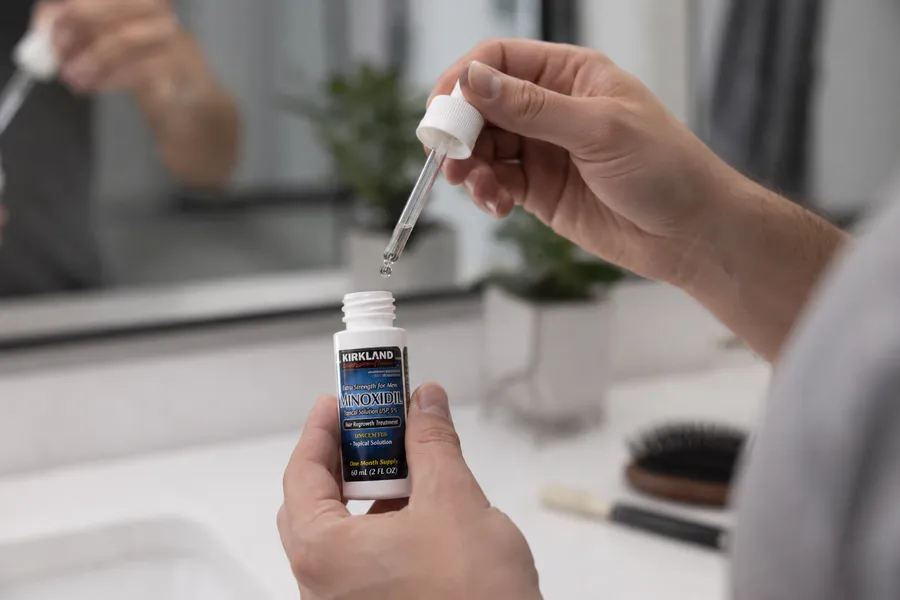
If you’re experiencing diffuse thinning, our article on minoxidil topical treatment walks through a complete protocol that can significantly slow loss before any surgical option is considered.
Practical FAQ
1. How should I pay on-site to avoid bank fees?
Never use a standard credit card at a Turkish ATM — you’ll absorb a double conversion (USD/TRY/USD) with fees of 3–5%. Best options: wire the deposit in advance by SEPA or international transfer (many clinics accept USD wire directly), or use a Wise or Revolut card at an ATM on a local bank network (Garanti Bankası, Yapı Kredi) to get interbank exchange rates. Avoid airport and hotel lobby ATMs — they charge the highest conversion fees.
2. How much social downtime should I realistically budget?
Plan for 10 to 14 days minimum before you can be around people without drawing attention. The first 72 hours, the scalp is visibly red and mildly swollen. From Day 3 to Day 10, the peri-follicular scabs are visible and honestly make the baldness look worse before it looks better. By Day 14, most crusts have shed and redness has significantly faded — but the grafts then enter their normal physiological shedding phase (shock loss), which lasts 4 to 8 weeks. You won’t see the final density result until Month 8 to Month 12.
3. When do the scabs fall off — and what if they don’t?
Peri-follicular scabs shed naturally between Days 10 and 14 with gentle lukewarm water washes and the baby shampoo your clinic recommends. Do not pick or scratch them — doing so pulls the graft out with the crust. If scabs persist past Day 20, it’s often a sign of mild infection or inadequate scalp hydration: consult a local doctor or dermatologist without waiting for your clinic’s next follow-up call.
4. Can I combine the transplant with topical minoxidil afterward?
Yes — but timing matters. Topical minoxidil must be paused at least 2 weeks before surgery (increased bleeding risk and scalp irritation) and should not be reapplied until Day 30 to Day 45 post-transplant, depending on recipient-area healing. Oral finasteride, by contrast, can generally be continued until 3 days before surgery and restarted from Day 7 — confirm this protocol with your surgeon.
5. Are Turkey transplant results equivalent to those from a Spanish or UK clinic?
Yes — if you choose a board-certified surgeon (ISHRS or EFHRS member) operating in a dedicated single-patient theater with a stable, vetted team. That standard exists in Turkey, Spain, the UK, and the US. The difference isn’t geographic — it’s structural. A genuine expert surgeon in Istanbul charges $3,200 to $5,000 for 3,000 grafts, which puts them on par with quality clinics in Spain or the UK. The EU regulatory framework in Spain adds specific legal protections that Turkey cannot offer — but the surgical outcome, in expert hands, is equivalent.
Travel Essentials for the Return Flight
The flight home from Istanbul is the most delicate 48 hours post-surgery. Cabin pressure changes, temperature shifts, and prolonged sitting all promote fluid buildup in the frontal zone. These are the three items Thomas and Elena consistently recommend packing before you board.
Anti-Edema Compression Headband
Essential for the flight home from Istanbul. Limits the descent of post-op edema onto the forehead and under the eyes during the critical first 48 hours — without touching the recipient graft zone.
- Limits edema migration onto the face
- Breathable medical-grade elastic fabric
- Velcro-adjustable for a custom fit
~$14.00
View on AmazonAffiliate link — We may earn a small commission at no extra cost to you.
Disposable Waterproof Bed Pads (Pack of 10)
Protects hotel and home bedding from the light lymph drainage that occurs during the first 3 to 5 nights. Don't risk unprotected pillows — minor seepage from the donor area can introduce infection risk on unprotected fabric.
- Protects bedding from post-surgical lymph drainage
- Sterile antimicrobial texture
- Ideal for the first 5 nights post-transplant
~$16.00
View Price on AmazonAffiliate link — We may earn a small commission at no extra cost to you.
Wide Brim UV Protection Sun Hat
Wide-brimmed structure protects the scalp from direct sun without pressing against fresh grafts. Essential at the Istanbul airport and on arrival home — unanchored grafts are extremely UV-sensitive for the first four weeks.
- Wide brim with zero contact on grafted scalp
- High-SPF UV protection
- Lightweight fabric suited to warm climates
~$19.00
View on AmazonAffiliate link — We may earn a small commission at no extra cost to you.
Sources and Clinical Studies
-
ISHRS (International Society of Hair Restoration Surgery) — 2023 Practice Census Results. Global data on surgical volumes, technique distribution (FUE, DHI, FUT) and geographic breakdown of certified surgeons. ishrs.org
-
Bernstein R.M., Rassman W.R. — “Follicular transplantation: patient evaluation and surgical planning.” Dermatologic Surgery, 1997; 23(9): 771–784. The foundational reference on follicular density per cm², donor area management, and surgical planning by Norwood stage.
-
Rose P.T., Nusbaum B. — “Robotic hair restoration.” Dermatologic Clinics, 2014; 32(1): 97–107. Comparative analysis of FUE and DHI extraction techniques, follicle survival rates, and the measurable impact of operator skill and daily patient volume on 12-month outcomes.