Medically reviewed by our internal trichology expert board.
Minoxidil 5% is probably the best-selling hair loss product on the planet. For thirty years it’s been sold over the counter — in pharmacies, on Amazon, occasionally in supermarkets. Millions of men have tried it. And the majority of them used it wrong.
Wrong dose. Wrong technique. Abandoned after the first month because hair seemed to fall out harder than ever — which was, in fact, the exact sign that it was working. Or ditched at the six-month mark because results weren’t “dramatic enough,” without understanding that Minoxidil doesn’t resurrect dead follicles: it stabilises and densifies the ones still alive.
Here’s what Minoxidil can genuinely do for you, what it will never do, and how to use it correctly. It starts with understanding the mechanism — and ends with a truth most men would rather not hear: if you start, you cannot stop.
The Science: Vasodilation, Potassium Channels, and the Anagen Phase
Minoxidil was not originally a hair drug. It’s an oral antihypertensive — developed in the 1960s to treat severe high blood pressure. Doctors quickly noticed an unexpected side effect: significant body and scalp hair growth in treated patients. The research followed from there.
The Core Mechanism: ATP-Sensitive Potassium Channel Activation
At the cellular level, Minoxidil acts as an activator of ATP-sensitive potassium channels (K⁺-ATP) present in the smooth muscle cells of vascular walls. By opening these channels, it triggers cellular hyperpolarisation — which translates to relaxation of arteriolar smooth muscle and therefore localised vasodilation.
At the scalp, this vasodilation increases blood flow to hair follicles. More blood means more oxygen, more nutrients (amino acids, growth factors), and better clearance of metabolic waste. Follicles that are struggling — miniaturised but not yet dead — find themselves in a more favourable environment to resume activity.
The Effect on the Anagen Phase
Minoxidil’s second documented action targets the hair cycle itself. A follicle cycles through three phases: anagen (active growth), catagen (regression), telogen (rest then shedding). In androgenetic alopecia, DHT progressively shortens the anagen phase and extends the telogen phase. The result: progressively shorter, finer hair with faster-turning cycles.
Minoxidil is able to extend the anagen phase in still-active follicles and to accelerate the transition from telogen to anagen in resting follicles. This second mechanism is precisely what drives the shedding effect in Month 1 — which we’ll cover in full detail below.
💡 Thomas R.’s Take: “What I consistently observe in the men I work with is that Minoxidil works better and faster when they understand the mechanism. Knowing why you have scalp redness in Week 1 (normal vasodilation), why you’re losing more hair in Weeks 3–5 (cycle synchronisation) — it changes everything about whether you stay the course. The men who quit during the shedding phase are almost always the ones who would have seen the best results. That’s a cruel irony.”
What Minoxidil Cannot Do
Let’s be direct. Minoxidil does not act on DHT. It doesn’t block 5-alpha reductase, doesn’t reduce circulating dihydrotestosterone, and doesn’t prevent androgen-driven follicle miniaturisation. It is a vascular and cycle-stimulation mechanism — not a hormonal one.
The direct consequence: if you’re noticing the first signs of baldness in your 20s and want to address the hormonal root cause, Minoxidil alone won’t be enough. The majority of trichologists recommend combining Minoxidil with Finasteride for maximum efficacy against androgenetic alopecia. That’s a separate conversation — but one worth having with your GP.
Foam vs Liquid Minoxidil: Pick Your Format in 3 Questions
Minoxidil 5% comes in two distinct formulations that are not interchangeable based on your profile. Use the selector below to find out which one is right for you.
Selector · 3 Questions
Foam vs Liquid Minoxidil — Which One for You ?
Question 1 / 3
What's your scalp type ?
💡 Selection algorithm validated by Thomas R., Hair Restoration Specialist.
The Shedding Phase: Why Losing More Hair in Month 1 Is a Good Sign
This is the moment that kills most Minoxidil protocols before they ever have a chance to work. Week 3, Week 4, sometimes Week 5: you look at your brush, your shower drain, your pillow. You’re convinced you’re losing twice as much hair as before you started. You panic. You stop.
Critical mistake.
What’s Happening Biologically
Remember: one of Minoxidil’s documented actions is to accelerate the shift of follicles from telogen (rest) to anagen (active growth). For a follicle to restart in anagen, it first has to eject the telogen hair it’s carrying — the strand that was already “queued for shedding.” This is a normal physiological process, but Minoxidil synchronises and accelerates it across a large number of follicles simultaneously.
The result: in Weeks 3–5, a significant proportion of your resting follicles simultaneously eject their telogen hair to launch a new anagen cycle. You lose more hair than usual — but these are strands that were going to fall regardless. The difference: they’re falling now to make room for newly active hair, rather than stagnating in a holding pattern.
How Long Does Shedding Last?
In the vast majority of cases: 2 to 6 weeks. Rarely beyond 8 weeks. If increased shedding continues past 3 months, see a dermatologist — that’s no longer Minoxidil shedding, it’s a separate phenomenon that needs identifying.
💡 Thomas R.’s Take: “I systematically prepare every man I work with for this moment, because I know that without preparation, they will quit. I tell them: ‘In 3–4 weeks, you’re going to think the product is destroying your hair. It’s doing the exact opposite. Take a photo now. Take one in 5 months. You’ll understand.’ Shedding is such a strong positive indicator that some trichologists use it as a treatment response marker: if you don’t shed in the first weeks, Minoxidil probably hasn’t reached the target follicles.”
The Rule You Need to Remember
Never evaluate Minoxidil’s efficacy before 4 months of strict protocol. The first visible results — improved density, baby hairs, reduced daily shedding — typically appear between Month 4 and Month 6. Optimal results are assessed at 12 months. Not before.
Minoxidil 5% Foam
Propylene glycol-free formula — eliminates reactive itching. Dries in 2 minutes, ideal for sensitive scalps and busy mornings.
- Dries in 2 minutes
- No Propylene Glycol (anti-itch)
- 3-month supply
~$45.00
View price on AmazonAffiliate link
The Strict Application Protocol: Doses, Frequency, Dry Scalp
The difference between mediocre and solid results with Minoxidil isn’t the brand. It’s the protocol. Here’s the only one that works.
The Fundamental Rule: Completely Dry Hair and Scalp
Topical Minoxidil — foam or liquid — must be applied to a completely dry scalp. Not damp. Not slightly wet. Dry.
Water dilutes the active ingredient and reduces its contact with the scalp. It also disrupts absorption: wet skin has a different barrier structure than dry skin, which alters the cutaneous penetration of Minoxidil in unpredictable ways. Applying Minoxidil to wet hair is throwing part of the product away — and potentially increasing systemic absorption through unintended pathways.
Wait at least 30 minutes after showering or shampooing before applying.
Doses and Frequency
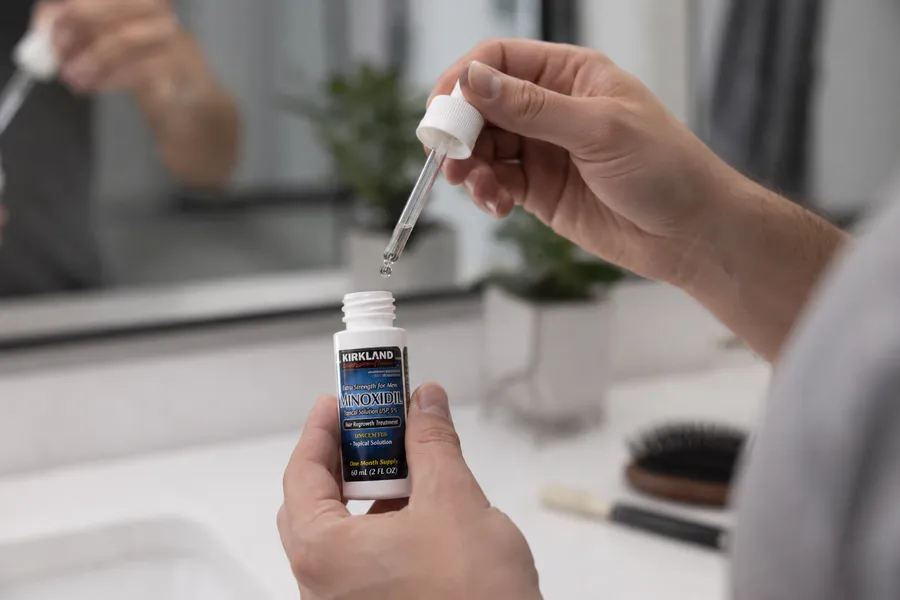
- Liquid Minoxidil: 1 ml per application, twice daily (morning and evening), distributed over thinning areas. Use the graduated dropper — not approximately, exactly 1 ml.
- Foam Minoxidil: half a capful (approximately 0.5 g of foam) per application, twice daily. Warm slightly in your palm, then distribute with your fingers over the target areas.
- Frequency: 2× per day, every day, no exceptions. Comparative studies between 1× and 2× daily applications consistently show better outcomes with twice-daily use. Once-daily application yields approximately 60–70% of the results of twice-daily dosing.
Target Zones: Vertex and Temples Only
Do not apply Minoxidil across your entire scalp out of caution or generosity. It works locally — precisely where you apply it. Target areas of low density: the vertex (crown), the temples. Not the full scalp, not the lengths, and absolutely not near the eyes.
After Application: Absorption Time
Wait at least 4 hours before washing your hair after any application. Ideally, apply in the evening — the overnight window allows optimal absorption without interference from styling products or sweat.
Do not wear a cap, beanie, or hat within 4 hours of application: occlusion accelerates absorption in an uncontrolled manner and can increase systemic effects.
Wash Your Hands Immediately Afterwards
Minoxidil can cause unwanted hair growth (hypertrichosis) if the product contacts other body areas. Wash your hands as soon as the application is done. This is not optional.
💡 Thomas R.’s Take: “The dry-scalp rule is the most violated of all. I hear from men who say Minoxidil isn’t working for them, and when I dig into their protocol, they’re applying it on damp hair ‘because it’s easier right after the shower.’ That’s a waste of time and money. And the 4-hour rule before shampooing — almost nobody respects it. Your Minoxidil costs $35–45 a bottle. Treat it like the medication it is, not a styling gel.”
Minoxidil 5% Liquid with Dropper
Graduated dropper for precise application on the crown and temples, even through longer hair. Economy format for a treatment that runs for years.
- Dropper penetrates longer hair
- Economy format
- Precise application on the vertex
~$35.00
View price on AmazonAffiliate link
The Ultimate Hack: Minoxidil + Dermaroller Synergy — and the 24h Rule
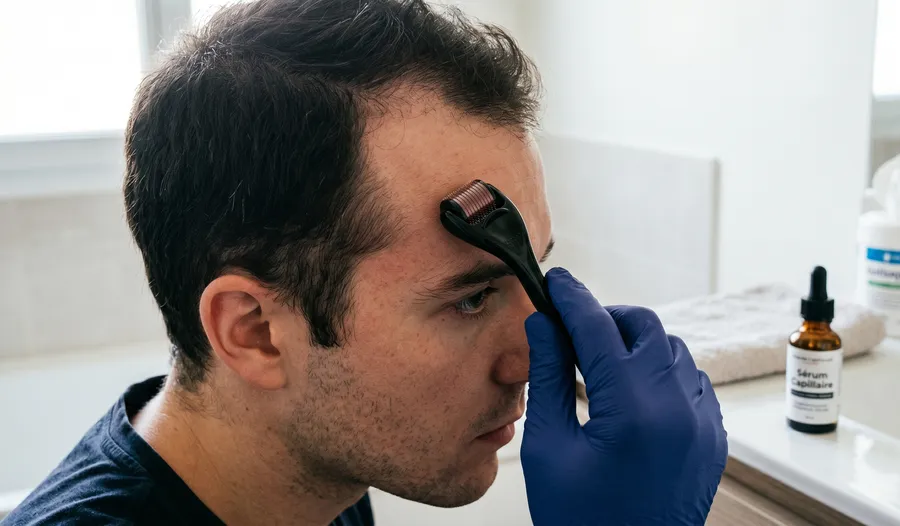
If you’ve been using Minoxidil correctly for 4–6 months and want to optimise your results, there is one combination with clinically documented efficacy: using a dermaroller alongside your Minoxidil protocol.
Why It Works: Microneedling Stimulates Two Complementary Pathways
The dermaroller (or microneedling device) creates micro-perforations in the scalp using fine needles (0.5 mm to 1.5 mm depending on the protocol). These controlled micro-traumas trigger a tissue repair cascade that produces two distinct benefits for hair regrowth:
- Growth factor release: VEGF (Vascular Endothelial Growth Factor), FGF-7 (Fibroblast Growth Factor 7), and PDGF (Platelet-Derived Growth Factor) — all directly involved in revascularisation and follicular reactivation.
- Increased Minoxidil cutaneous absorption: the micro-channels created by the needles allow the active ingredient to penetrate significantly deeper, reaching target follicles more effectively.
The Dhurat et al. (2013) study compared Minoxidil alone vs Minoxidil combined with weekly microneedling over 12 weeks: the combined group showed a hair count increase of +91.4 on average vs +22.2 for Minoxidil alone. A 4× efficacy multiplier.
The 24h Rule: A Non-Negotiable Constraint
This is the most important rule of this combination — and the most ignored, because the apparent logic pushes in the opposite direction.
NEVER apply Minoxidil within 24 hours of a dermaroller session.
The micro-channels created by the needles massively increase cutaneous absorption of everything applied to the scalp. If you apply Minoxidil in the hours following a session, an abnormally high quantity of active ingredient enters systemic circulation — well beyond the doses expected from a normal topical application.
Possible consequences: hypotension, heart palpitations, oedema. This isn’t theoretical — these are reported effects in users who combined the two without respecting this delay.
Correct protocol:
- Day 0: dermaroller session only. No Minoxidil that evening.
- Day +1 (24h later): resume your normal twice-daily Minoxidil protocol.
- Dermaroller frequency: once per week at 0.5 mm, or once every two weeks at 1.0 mm.
💡 Thomas R.’s Take: “The 24h rule is the one thing that genuinely concerns me about this combination. Because the instinct is to apply Minoxidil immediately after the dermaroller — ‘so it absorbs better.’ And you’re right, it does absorb better. So much better that you take in 5 to 10 times the intended dose systemically. The palpitations, the dizziness, the blood pressure drops that some users report — it’s almost always this. Wait 24 hours. That’s not a suggestion.”
Nizoral Shampoo (Ketoconazole 2%)
The perfect scalp companion. Ketoconazole reduces reactive dandruff caused by propylene glycol and has documented local anti-DHT activity.
- Ketoconazole 2% anti-dandruff
- Topical anti-DHT activity
- Compatible with Minoxidil
~$15.00
View price on AmazonAffiliate link
If microneedling isn’t for you, light-based stimulation is the other device route with real trial data behind it — see our laser hair growth comb reviews for the protocol and the models actually worth buying.
FAQ & Side Effects
Which Side Effects Are Actually Documented?
Topical Minoxidil 5% has a generally good safety profile for localised use. Common side effects and their root causes:
Scalp itching and reactive dandruff: in 90% of cases, caused by the propylene glycol in the liquid formulation — not by Minoxidil itself. Solution: switch to foam (propylene glycol-free), or use a ketoconazole 2% shampoo (Nizoral) 2–3 times per week to rebalance the scalp.
Hypertrichosis (unwanted hair growth on the face, forehead, arms): results from accidental skin contact with the product. Wash your hands immediately after every application and avoid touching your face afterwards.
Palpitations, dizziness, mild hypotension: rare with correct topical use. Near-systematic when the product is applied immediately after a dermaroller session (see the 24h rule above) or on an aggressively shaved area. Consult a doctor if these symptoms persist.
Local redness in the first few weeks: a sign of the local vasodilation taking effect — biologically expected, harmless for most users. Typically fades after 2–4 weeks.
Is Minoxidil Toxic to Cats?
Yes. Formally and severely.
Minoxidil is highly toxic to cats through both ingestion and cutaneous absorption. Even very small quantities can cause fatal cardiac or renal failure in a cat. Reported poisoning cases often involve indirect contact: the cat licks its owner’s head after an application, or walks across a contaminated surface.
If you own a cat: wait until Minoxidil is completely dry before any animal contact, wash your hands thoroughly, and contact your vet immediately if you suspect exposure.
What Happens If I Stop Minoxidil?
This is the truth everyone would rather avoid. If you stop Minoxidil, you lose everything you’ve gained — within 3 to 6 months.
Minoxidil maintains follicles in an extended anagen phase through its vascular action. The moment you stop, follicles progressively return to their androgenetic miniaturisation rhythm. Hair that Minoxidil had densified becomes fine again, then sheds. In most cases, within 6 months of stopping you’re back to the hair state you would have had if you’d never started.
This is a lifetime commitment. Not an exaggeration — a biological reality.
💡 Thomas R.’s Take: “I tell every man this before he starts. Not to discourage him — so he makes an informed decision. If you start Minoxidil at 28, you’re probably taking it until 50, 60, maybe longer. That’s 30 minutes a week, $35–45 a month. For many men, it’s the best hair investment of their lives. But you need to make that call with your eyes open, not discover the stop-penalty after 18 months of results. Check the treatments page if you’re still comparing options — it covers every alternative in the same no-BS format.”
Can I Combine Minoxidil With Rosemary Oil?
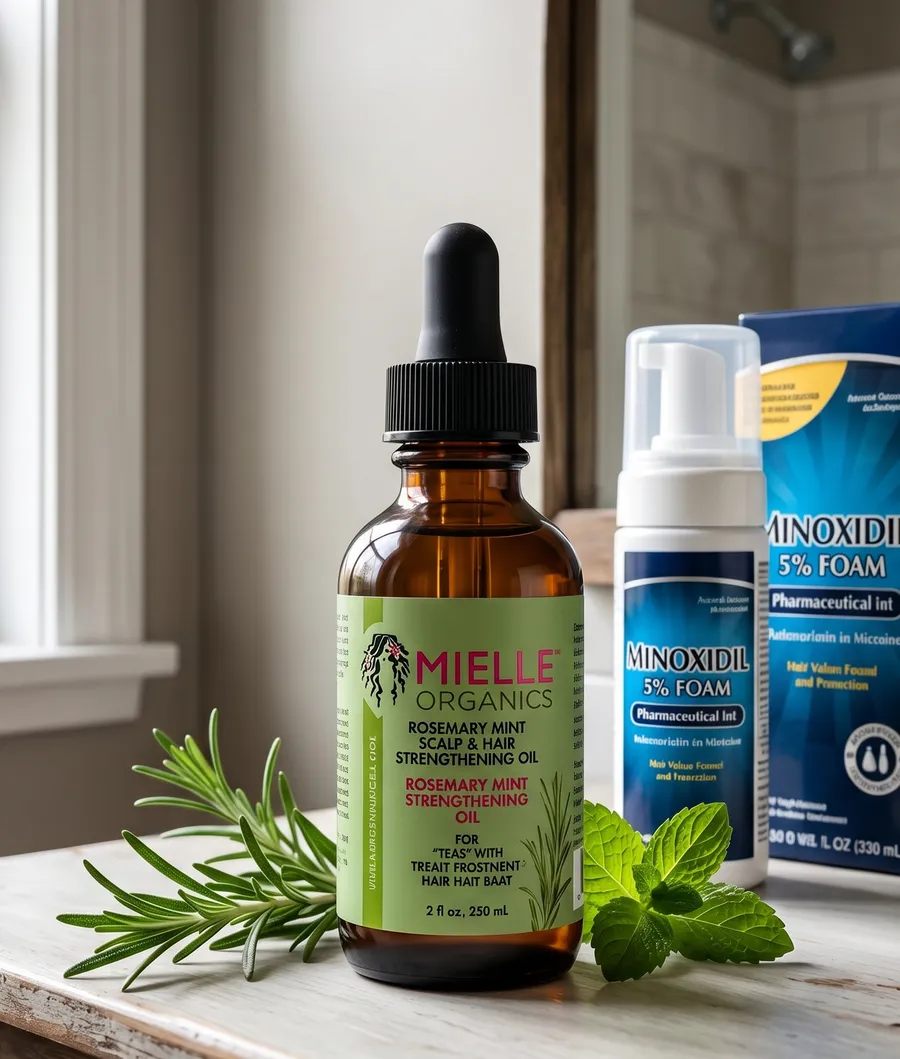
Yes — but not simultaneously. Minoxidil (vasodilation via K⁺-ATP channels) and rosemary oil (partial local 5-AR inhibition + microcirculation support) act through complementary pathways. The combination is biologically sound.
In practice: Minoxidil in the morning, rosemary oil in the evening — or vice versa. Never apply them at the same time: the oily film from rosemary creates a barrier that significantly reduces Minoxidil absorption.
Does Minoxidil Work at Every Stage of Baldness?
No. It’s most effective at Norwood II through IV — meaning when follicles are still active or partially miniaturised but not yet dead. At Norwood V through VII, follicles in completely bare zones are largely fibrosed. Minoxidil has zero effect on a dead follicle.
Practical rule: if you still see fine vellus hair over the area, follicles are potentially reactivable. If the skin has been smooth and shiny for years, Minoxidil won’t do anything there. In that case, an FUE hair transplant is the only realistic path forward.
How Long Until Visible Results?
| Timeline | What to Expect |
|---|---|
| Months 1–2 | Possible shedding (positive sign). No visible result. |
| Months 3–4 | Reduced daily shedding. First baby hairs possible. |
| Months 5–6 | Visible densification, regrowth in lightly thinning areas. |
| Months 9–12 | Optimal results — the real benchmark. |
Don’t judge before 4 months. Don’t conclude before 12.
Clinical Sources
-
Olsen EA, et al. — A randomized clinical trial of 5% topical minoxidil versus 2% topical minoxidil and placebo in the treatment of androgenetic alopecia in men. Journal of the American Academy of Dermatology, 2002. PubMed
-
Dhurat R, et al. — A randomized evaluator blinded study of effect of microneedling in androgenetic alopecia: a pilot study. International Journal of Trichology, 2013. PubMed
-
Messenger AG, Rundegren J. — Minoxidil: mechanisms of action on hair growth. British Journal of Dermatology, 2004. PubMed