Medically reviewed by our internal dermatology expert board.
In 2023, #rosemaryoil crossed 4 billion views on TikTok. Women filmed before-and-after clips, claimed to have reversed shedding in three months, and positioned Mielle Organics rosemary oil as the hair-growth discovery of the decade. The enthusiasm is real. The misinformation is too.
Behind the trend sits exactly one serious randomised controlled trial. Its results are real — and encouraging. But the precise conditions, limitations, and scope of that research are systematically stripped out in TikTok summaries. That’s what sends thousands of people toward the wrong product for their hair loss type, burning months that could have been spent on something that actually works for them.
This article is written by two people. Thomas R. has spent twelve years following men with receding hairlines and has zero interest in selling you false hope. Elena S. covers the female angle: diffuse shedding, postpartum loss, baby hairs, scalp hydration. Two clinical perspectives. No marketing fluff.
Take the quiz below first. Thirty seconds. It could save you six months of trial and error.
Eligibility Test · 3 questions
Is rosemary oil right for your hair loss?
Answer in 30 seconds. Personalised result — not a generic recommendation.
Question 1 / 3
What is your hair loss type?
💡 Clinical targeting algorithm validated by Elena S. & Thomas R.
The Panahi 2015 Study: What It Actually Says — and What It Doesn’t
Published in the peer-reviewed journal Skinmed, Yunes Panahi’s research remains to this day the only double-blind randomised trial comparing rosemary extract to a clinically recognised hair loss treatment. That’s both its strength and its fundamental limitation.
What the study actually tested
- Population: 100 men with mild to moderate androgenetic alopecia (Norwood stages II to IV)
- Duration: 6 months of daily application, twice per day
- Groups: 50 using rosemary oil, 50 using 2% Minoxidil solution
- Application: 2-minute scalp massage at each application
- Primary measure: standardised hair count via photography in a defined target zone (vertex and temporal regions)
What the results actually show
At 6 months, both groups showed a statistically significant increase in hair count compared to baseline. The difference between the two groups was not statistically significant — meaning rosemary oil achieved comparable efficacy to Minoxidil 2% in this specific protocol, on this specific population.
A finding that rarely makes it into the TikTok summaries: the Minoxidil group reported significantly more scalp itching early in the protocol. The likely culprit is propylene glycol, the penetration enhancer used in lotion-format Minoxidil. The rosemary group reported no notable side effects.
The molecular mechanism: how rosemary actually blocks DHT
This is the part nobody explains on social media. Understanding how rosemary works is the key to understanding who it can work for.
Androgenetic alopecia (pattern baldness) is driven by dihydrotestosterone (DHT), an androgen derived from testosterone via an enzyme called 5-alpha reductase type II (5-AR2). This enzyme is heavily concentrated in the follicles of the scalp’s crown and temples — precisely where pattern hair loss progresses. DHT binds to androgen receptors in the follicle, progressively shortening the anagen (growth) phase and causing follicular miniaturisation: the hair shaft becomes thinner and shorter with each cycle until the follicle stops producing visible hair entirely.
Rosmarinic acid — rosemary’s primary polyphenol — acts as a competitive inhibitor of 5-AR2. In practical terms: it occupies some of the enzyme’s binding sites, reducing its ability to convert testosterone into DHT at the follicular level. This is not a total inhibition like finasteride (an oral drug that blocks 5-AR systemically throughout the body), but a localised, partial, and reversible one. Gentler. Less potent. That’s the trade-off.
The Yoon et al. study (2010, Annals of Dermatology) confirmed rosmarinic acid’s inhibitory properties on 5-AR in vitro. Murata et al. (2013) documented accelerated follicular growth phases in a murine model.
Four limitations the TikTok summaries always skip
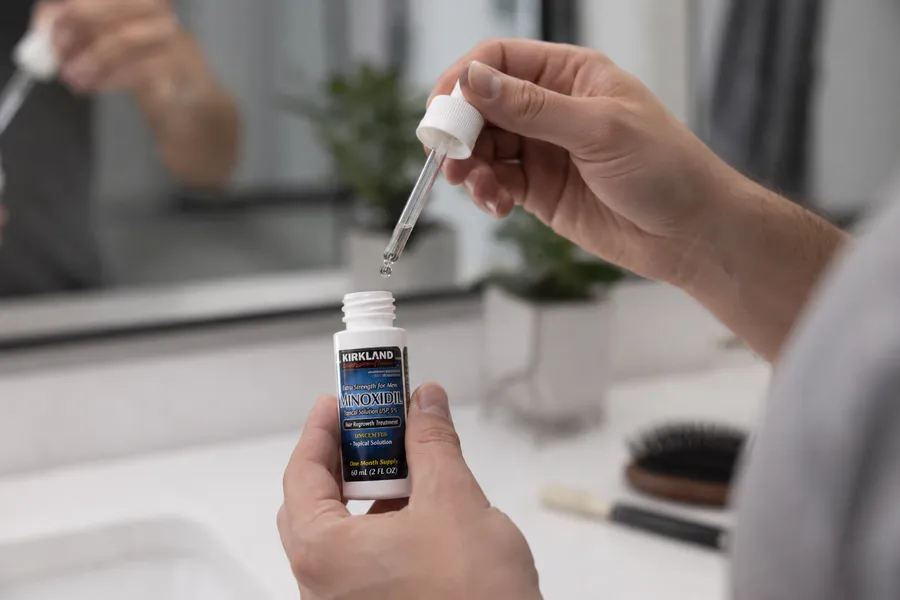
- 2% Minoxidil, not 5%. Minoxidil 5% is two to three times more effective than the 2% formula in comparative trials. Claiming rosemary is “as effective as Minoxidil” without that caveat is misleading.
- 100% male population. No women were included. Extrapolating these results to female hair loss — which often has different underlying causes — is an assumption, not a finding.
- Norwood II to IV only. Advanced stages (V, VI, VII) were not studied. At those stages, follicular death and fibrosis have often already occurred.
- Never replicated at scale. One trial, however solid, does not make a consensus.
💡 Thomas R.’s Take (Men): “I’m straight with everyone who comes in holding their Mielle bottle. If you’re Norwood 3 and your crown is visibly thinning through the hair, rosemary oil will not save your temples. Biologically, it can’t — follicles miniaturised for years don’t respond to a partial 5-AR inhibitor. But if you’re 22, your hairline has just started shifting slightly, and you want something natural before committing to a daily medication — that’s a reasonable conversation. Norwood 2: yes, worth trying. Norwood 4: stop experimenting and read the Minoxidil protocol before you lose any more ground.”
💡 Elena S.’s Advice (Women): “The Panahi study only covers men with androgenetic alopecia — a DHT-driven loss pattern. The majority of female hair loss is first hormonal (postpartum, perimenopause, thyroid), nutritional (low ferritin, vitamin D deficiency), or traction-related. The mechanism is different. The study’s conclusions don’t map cleanly onto a woman losing her hair three months after giving birth. That doesn’t make rosemary useless for her — it means it works via a different pathway, primarily microcirculation rather than DHT inhibition.”
Men vs Women: Two Types of Hair Loss, Two Treatment Logics
The most persistent error in popular hair loss coverage is treating hair loss as a single, uniform condition. It isn’t. The biology, mechanisms, and therapeutic priorities are fundamentally different by sex.
Men: DHT is the primary enemy
In the vast majority of men experiencing hair loss, the culprit is clearly identified: androgenetic alopecia. DHT miniaturises follicles in a predictable, progressive pattern — temples recede, crown thins, Norwood stages advance if nothing intervenes.
For a man in this situation, rosemary’s value proposition is precise: partial local inhibition of 5-AR2, slowing DHT production at still-active follicles. A low-intensity anti-DHT action, without the systemic side-effect profile of finasteride (reported erectile dysfunction and libido changes in a subset of users). Useful as prevention or adjunct. Insufficient as a standalone treatment once significant baldness is established.
💡 Thomas R.’s Take (Men): “Let me be direct: if your reason for considering rosemary oil is specifically to avoid starting Minoxidil because you’re worried about depending on it long-term — that’s actually a legitimate reason. At Norwood 2, with regular use, you’re buying time and potentially slowing progression. But if you’ve been watching your hairline move for three years and you’re still sitting on the fence, you’re not being cautious — you’re losing follicles. At some point you have to decide the goal is keeping your hair, not avoiding medication.”
Women: multiple causes, different sensitivities
Female hair loss is rarely single-cause. It can be hormonal (postpartum, perimenopause, thyroid dysfunction), nutritional (iron, ferritin, vitamin D), related to chronic traction (tight buns, extensions, braids), or a telogen effluvium triggered by stress or illness. Female androgenetic alopecia exists — but it typically presents as diffuse thinning rather than the Norwood recession pattern.
For a woman experiencing postpartum shedding, rosemary’s primary mechanism isn’t anti-DHT. It’s microcirculation stimulation — increasing oxygen and nutrient delivery to follicles stuck in extended telogen phase, helping them return to anagen.
For a woman with fine hair that lacks density, rosemary can reinforce the hair shaft and improve overall scalp circulation — without addressing the root cause if that cause is nutritional or hormonal.
💡 Elena S.’s Advice (Women): “Something I see constantly: women massively underestimate the impact of the scalp massage itself — independent of the rosemary. There’s documented evidence that four minutes of daily scalp massage increases follicular vascularisation over 24 weeks. The rosemary is an active vehicle, but the gesture is just as responsible for results as the molecule. And the other classic mistake: applying the oil only to the hair lengths to avoid greasing the roots. You’re missing the target entirely. The action happens at the bulb level — on the scalp, not on the fibre.”
Mielle Organics Formula: Why This Specific Blend
Not all “rosemary oils” are equal. Some are simply vegetable oils fragrance-infused with a few drops of rosemary essential oil. The Mielle Organics formula is different: it’s a three-active synergy, each ingredient playing a distinct, documented role.
Rosemary (Rosmarinus officinalis) — the 5-AR inhibitor
In the Mielle formula, rosemary is present as a standardised extract rich in rosmarinic acid, not as a pure essential oil. This distinction is critical. Pure rosemary EO is dominated by camphor (15–45% depending on chemotype) and 1,8-cineole (up to 50%) — volatile terpenes that can irritate an undiluted scalp. Rosmarinic acid is a water-soluble polyphenol that acts on 5-AR2. Chemically different compounds, completely different tolerability profiles.
Peppermint (Mentha piperita) — the natural vasodilator
Peppermint isn’t in this formula for fragrance. The Oh et al. study (2014, Toxicological Research) showed that a 3% menthol solution induced follicular growth comparable to 3% Minoxidil in a murine model. Menthol, peppermint’s active compound, is a cutaneous vasodilator acting via TRPM8 thermoreceptors in the skin. The tingling you feel on application isn’t cosmetic: it’s a physiological marker of active vasodilation.
Biotin (Vitamin B7) — keratin structural cofactor
Biotin is an enzymatic cofactor involved in keratin synthesis. Deficiency — common in postpartum women or those on certain oral contraceptives — weakens the hair shaft. Topical biotin has limited cutaneous penetration compared to oral supplementation, but it can reinforce the existing cuticle layer. Structural support, not hair regrowth.
💡 Elena S.’s Advice (Women): “Topical biotin doesn’t replace oral supplementation if you’re genuinely deficient — and many postpartum women are. Before spending money on products, run a blood panel: biotin, ferritin, vitamin D, TSH. A bottle of Mielle Organics won’t fix a ferritin level of 8 µg/L. Fix the internal deficit first; then the topical routine actually has something to work with.”
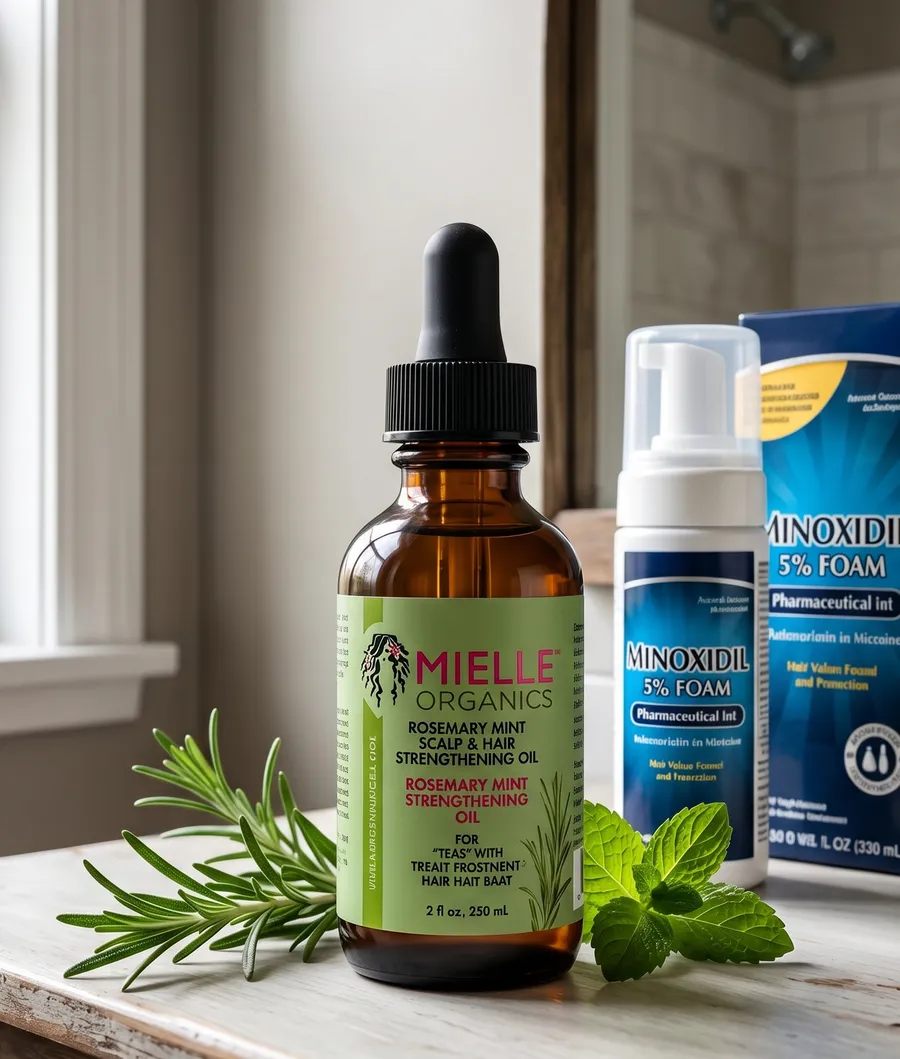
Mielle Organics · Rosemary & Peppermint Oil
Pre-diluted rosmarinic acid and menthol formula. The go-to starting point for a serious rosemary oil protocol — without the scalp-burn risk of raw essential oil.
- Sulfate-free
- Vegan
- Clinical Study 2015
$14.90
View on AmazonAffiliate link
Application Protocol: The Method for Your Profile
Rosemary oil’s effectiveness depends almost entirely on application discipline. The vast majority of “it didn’t work for me” reviews are the direct result of avoidable protocol errors.
Why pure essential oil burns the scalp
If you’re using a pure rosemary essential oil bought at a health store, you need to understand what makes it potentially irritating. Rosemary EOs contain between 15% and 45% camphor and up to 50% 1,8-cineole — volatile terpenes that are potent skin irritants at high concentrations. Applied neat to the scalp, they can trigger contact dermatitis, redness, and reactive flaking that temporarily worsens shedding.
The fix: dilute to a maximum 1–2% concentration in a carrier oil. Practical ratio: 3 to 6 drops of EO per 30ml of carrier. The Mielle formula eliminates this problem — it’s pre-diluted at a scalp-safe concentration.
The ideal carrier: castor oil or jojoba
Castor oil is the recommended carrier: its ricinoleic acid content (85–90%) has documented anti-inflammatory properties on the scalp, and its high viscosity slows evaporation. Jojoba is a lighter alternative for oily scalp types.
Pure Castor Oil · Cold-Pressed, Organic
The benchmark carrier for rosemary EO dilution: 85% ricinoleic acid with documented anti-inflammatory action. Mix at 1–2% for a scalp-safe rosemary blend.
- Certified Organic
- Cold-Pressed
- Anti-inflammatory
$9.90
View on AmazonAffiliate link
Men with short hair: the 3-minute protocol
- Quantity: 6 to 8 drops — no more. Excess saturates without increasing absorption.
- Placement: apply directly to low-density zones (temples, crown) at multiple points. Target, don’t blanket.
- Massage: firm circular movements with finger pads, minimum 2 minutes. Or a silicone scalp brush — it standardises pressure and covers more area.
- Leave-on time: minimum 30 minutes. Before washing — never overnight.
- Frequency: 3 times per week. Daily application can trigger reactive sebum overproduction.
💡 Thomas R.’s Take (Men): “The thing nobody actually does correctly: the massage duration. Two minutes sounds short but time yourself — most people stop at 40 seconds. The massage is what creates vasodilation. Oil without massage is 30% of the potential benefit. Massage without oil is 70%. Prioritise the technique.”
Women with long hair: the sectioning protocol
- Section the hair into 4 to 6 parts using clips. Each section exposes a line of accessible scalp.
- Apply 2 to 3 drops per section directly onto the exposed parting. A pipette applicator gives precision.
- Massage each section before moving to the next — 30 seconds per section, 3 minutes total.
- Don’t skip the baby hairs: the frontal and temporal zones are where stimulation is most needed. Don’t avoid them out of fear of weighing fine hair down.
- Rinse after 30 to 45 minutes with a gentle shampoo. No overnight treatments — prolonged occlusion suffocates follicles.
💡 Elena S.’s Advice (Women): “The baby-hair mistake I see constantly: women skip the temples entirely because they’re worried about weighing down fine hairs. They massage the crown while completely missing the area where female hair loss most visibly begins. The baby hairs themselves shouldn’t be coated — but the scalp underneath, at the temples and the hairline, absolutely needs massaging.”
Scalp Massager Brush · Medical-Grade Silicone
Standardises massage pressure, reaches hard-to-access zones, and works in the shower. 2 minutes with this brush delivers more effective vasodilation than 5 minutes with fingertips alone.
- Medical-grade silicone
- Waterproof
- Shower-safe
$12.90
View on AmazonAffiliate link
The overnight oil-soak mistake: why it suffocates the bulb
Applying several tablespoons of oil, wrapping in a warm towel, leaving overnight — it sounds intensive but it’s counterproductive. Excessive oil left on the scalp blocks the follicular ostia — the openings through which hair emerges. The result: reactive seborrhoea, low-grade inflammation, and sometimes accelerated shedding. Cutaneous lipid penetration plateaus at 20 to 30 minutes. Everything after that is an occlusive film creating more problems than it solves.
The counter-intuitive rule: less, more often, always massaged.
Rosemary Oil vs Minoxidil: The Honest Comparison
For women experiencing postpartum diffuse shedding, rosemary oil is a clinically reasonable option: safe at topical diluted concentrations during breastfeeding, no documented rebound shedding on discontinuation, and a mechanism coherent with their physiology. Our women’s hair loss hub covers when Minoxidil 5% becomes necessary for more advanced stages.
| Rosemary Oil | Minoxidil 2% | Minoxidil 5% | |
|---|---|---|---|
| Proven clinical efficacy | Mild hair loss | Mild to moderate | Moderate to severe |
| Time to visible results | 3 to 6 months | 3 to 4 months | 2 to 4 months |
| Side effects | Near zero | Scalp irritation (propylene glycol) | Possible hypertrichosis |
| Contraindicated in pregnancy | No (diluted topical) | Yes | Yes |
| Rebound shedding on stop | Not documented | Yes, systematic | Yes, systematic |
| Est. monthly cost | ~$6 | ~$12 | ~$15–20 |
| Recommended Norwood stage | I–II | II–III | II–IV |
💡 Thomas R.’s Take (Men): “The real question isn’t ‘rosemary or Minoxidil?’ — it’s ‘can I afford to spend 6 months finding out if this works?’ At 22 with a slightly shifting hairline, yes. At 35 with a crown that’s been thinning for three years, no. Every month of deliberation is follicles you don’t recover. If our Minoxidil guide fits your profile, start. You can always add rosemary as a complementary evening treatment.”
FAQ: Real Questions, Straight Answers
Is rosemary oil safe during pregnancy or breastfeeding?
In diluted topical form (1–2%), no published data signals risk to the foetus or nursing infant. Cutaneous absorption at these concentrations is minimal. Rule: pre-diluted formula only (Mielle Organics). No pure EO.
Pure rosemary essential oil taken orally or applied undiluted is a separate matter: it contains emmenagogue compounds (camphor, verbenone) that can stimulate uterine contractions at high doses. Formally contraindicated orally throughout pregnancy.
Will it make my hair greasy?
If applied correctly to the scalp only — no. 5 to 8 drops on the scalp, massaged in, rinsed after 30 minutes, no contact with the hair lengths. Greasiness always comes from excess product, leaving it on too long, or applying it to the lengths rather than the scalp.
I get headaches after using rosemary EO. Why?
With Mielle Organics (pre-diluted), this is rare. With pure rosemary EO, it’s a common and documented response — camphor and cineole are volatile compounds with an intense smell that, in an enclosed space, can cause headaches and mild dizziness. Three fixes: dilute further (down to 0.5%), ventilate the room during application, or switch to the pre-diluted formula.
How long until I see results?
Don’t expect anything before month 3 of a consistent protocol. First visible effects — slightly improved density, baby hairs thickening, less shedding in the shower — typically appear between months 3 and 5. If there’s no observable change after 6 months of rigorous three-times-weekly application, rosemary oil is not matched to your hair loss type. Consult a trichology-specialised dermatologist.
Can I combine rosemary oil with Minoxidil?
Yes — and the combination has real biological rationale. They act through different pathways (local 5-AR inhibition + microcirculation vs potassium channel opening + systemic vasodilation). Minoxidil in the morning, rosemary in the evening. Never simultaneously — the oil film from rosemary significantly reduces Minoxidil’s cutaneous absorption.
Does rosemary oil work for traction alopecia?
Partially, and only at early stages when follicles are still alive and loss is still reversible. At an advanced stage with established follicular fibrosis, no topical product will restart growth. Stopping the traction is the most critical intervention before any topical treatment.
💡 Elena S.’s Advice (Women): “I’ll say this plainly: if you’ve been wearing a tight bun or braids every day for years and your frontal hairline has receded significantly, the immediate priority is stopping the traction — not buying rosemary oil. The oil doesn’t counteract an active mechanical cause. Remove the cause first, then use rosemary as part of the recovery support.”
Sources & Clinical References
- Panahi Y, et al. — Rosemary oil vs minoxidil 2% for the treatment of androgenetic alopecia: a randomized comparative trial. Skinmed, 2015.
- Murata K, et al. — Promotion of hair growth by Rosmarinus officinalis leaf extract. Phytotherapy Research, 2013.
- Oh JY, et al. — Peppermint oil promotes hair growth without toxic signs. Toxicological Research, 2014.
- Yoon JI, et al. — Rosemary extract inhibits 5-alpha reductase and has hair growth promoting activity. Annals of Dermatology, 2010.
- Trueb RM. — Pharmacologic interventions in aging hair. Clinical Interventions in Aging, 2006.
- Starace M, et al. — Female androgenetic alopecia: an update on diagnosis and management. American Journal of Clinical Dermatology, 2020.