
Medically reviewed by our internal dermatology expert board.
You’re standing in the bathroom. Brush in hand. And what you see stops you cold — more hair than you’ve ever seen in your life, caught between your fingers, draped over the drain.
Maybe it’s the third time this week you’ve counted the strands on your pillow. Or stared at the shower floor with that particular mix of dread and sheer exhaustion — because you’re already running on empty, because sleep stopped being sleep weeks ago, and now, on top of everything else, your hair is leaving.
Here’s what no one tells you clearly enough: what you’re experiencing has a scientific name, a precise explanation, and a predictable endpoint. It is not a disease. It is not baldness. And in the vast majority of cases, it is completely reversible.
This guide will not sell you $60 gummy vitamins that promise to fix everything in two weeks. It will give you the truth about what’s happening inside your follicles — and the few things that actually make a difference. For a broader look at female hair loss causes and treatments, see our women’s hair loss guide. If you’re also noticing your hair is getting finer over time rather than just shedding, you may be dealing with two separate issues — see our guide to thickening fine hair in women.
Why your body does this — and no, you are not sick
To understand postpartum shedding, you need to go back to pregnancy itself.
For nine months, your body is flooded with extraordinarily high estrogen levels — sometimes ten to fifteen times higher than your baseline. These hormones have a direct, well-documented effect on the hair cycle: they keep your follicles locked in the anagen phase, the active growth phase.
Under normal circumstances, about 85% of your follicles are in the growth phase at any given moment. During pregnancy, that figure can climb to 95%. That’s why so many pregnant women have their best hair — thicker, shinier, denser. Your follicles simply aren’t shedding.
Then delivery happens.
Within 24 to 48 hours, your estrogen crashes back to pre-pregnancy levels. It’s abrupt, hormonal, and entirely expected. But for your follicles, this hormonal signal triggers something very specific: they synchronize. All those follicles that were held artificially in growth simultaneously enter the telogen phase — the resting phase that precedes shedding.
This is called postpartum telogen effluvium.
The shedding doesn’t start immediately. There’s a physiological delay of two to three months between entering telogen and the hair actually falling out. That’s why the heaviest shedding typically begins between two and four months postpartum — not right after birth.
This mechanism is the key to not panicking: the bulbs are alive. The follicle doesn’t die. It rests. And when it exits that resting phase, it will produce a new hair.
💡 Elena S.’s take: “The first thing I say to new mothers who arrive in tears with a fistful of shed hair is: show me your baby. Then I explain that their hair was doing exactly what it was designed to do — sustaining the pregnant body. Now it’s recalibrating. This is not a disease. It’s biology.”
The postpartum shedding timeline: where are you?
Every woman experiences telogen effluvium at a slightly different pace. But the broad phases are predictable. Use this tool to find your place in the timeline.
Quick Evaluator · Postpartum
Where are you in the timeline?
One question, an instant answer. Understand what's happening without the panic.
How old is your baby?
💡 Physiological cycle validated by Elena S.
Regardless of your phase, the key thing to understand is this: postpartum shedding follows a bell curve. It rises, peaks, then falls. The “baby hairs” — those short, soft, slightly wavy strands that appear along the hairline — are the most reassuring sign of active regrowth. When you see them, the cycle has restarted.
When postpartum shedding becomes a real red flag
Postpartum shedding is normal. But certain signs should prompt you to see your doctor or a dermatologist — not to panic, but to rule out underlying causes that are very treatable once identified.
Signs that warrant a blood panel
1. Heavy shedding that hasn’t slowed by month 12
Physiological postpartum telogen effluvium typically resolves within 3 to 6 months, with full recovery by 12 months in most cases. If you’re still shedding at the same intensity at the one-year mark, there’s an underlying cause to identify.
2. A receding hairline or thinning temples
Postpartum shedding affects the whole scalp evenly — it doesn’t create bald patches or a retreating hairline. If you notice your frontal hairline pulling back or diffuse thinning across the crown that’s getting worse, this is the pattern of female androgenetic alopecia (FAGA) — a different condition requiring a different approach.
3. A burning, itchy, or painful scalp
A scalp that burns or itches alongside shedding may indicate seborrheic dermatitis, lichen planopilaris, or folliculitis — inflammatory conditions that worsen hair loss and need targeted treatment.
4. Eyelash or eyebrow loss
This points toward alopecia areata or an autoimmune trigger — more common postpartum, as the immune system reorganizes after delivery.
The blood panel to request
If you have any doubt, ask for these specific tests:
- Ferritin: the most sensitive marker for hair health. Ideally above 70 ng/mL. Below 30 is insufficient. Iron deficiency is the number-one hidden driver of persistent shedding in women, and it is massively under-diagnosed postpartum (birth bleeding + breastfeeding deplete stores rapidly).
- TSH: to screen for postpartum thyroiditis — an autoimmune condition affecting 5–10% of women in the year after delivery, often with hair loss as its first visible symptom.
- Full blood count (FBC/CBC): to detect anemia.
- Zinc and Vitamin D: two micronutrients frequently depleted postpartum, both involved in the follicular cycle.
💡 Elena S.’s take: “The classic trap: the doctor checks hemoglobin and says ‘your iron is fine.’ But hemoglobin is the last marker to drop — ferritin collapses first. Specifically ask for a ferritin level. If it’s below 50, you have a partial answer. If it’s below 30, you have your main answer.”
An honest word about hair gummies and supplements
Biotin-based, keratin-based, or “hair complex” gummies sold at drugstores will not regrow your hair in two weeks. That’s biologically impossible — the follicular cycle takes months.
Biotin only helps if you have an actual biotin deficiency (rare). Correcting a real ferritin or vitamin D deficiency, however, has a measurable impact on shedding duration and intensity. The difference: one addresses an identified cause, the other addresses a marketing gap.
What actually makes a difference day to day
During the shedding phase, your hair shafts are fragile — not just the roots. The goal is twofold: preserve visible density by limiting mechanical breakage, and nourish the follicle from the inside to shorten the telogen phase.
Washing: gentleness is non-negotiable
Use lukewarm or cool water. Dilute your shampoo in your palm before applying. Never use your nails — use your fingertips with light circular pressure, no friction. After rinsing, press — never rub — with your towel. Friction breaks the shaft, which is already fragile in telogen.
A sulfate-free volumizing shampoo is your best ally right now: it cleanses without stripping protective sebum, and its thickening formula creates the visual illusion of density in the hair that remains.
Sulfate-Free Volumizing Shampoo · Gentle Formula
No SLS or SLES · Natural thickening agents · Ideal for sensitive postpartum scalp · Breastfeeding-friendly formula
- Sulfate-free
- Volumizing
- Postpartum
$14.90
View on AmazonAffiliate link
At night: protect fragile hair from mechanical breakage
Every night, your hair rubs against your pillowcase for 6 to 8 hours. On standard cotton, this friction creates micro-tears in the hair shaft — especially damaging when strands are already in telogen and weakened.
A natural silk pillowcase significantly reduces this friction. Silk is smooth, non-absorbent (unlike cotton, which wicks moisture from your hair), and glides without snagging. This is pure mechanical protection, not a wellness gimmick.
💡 Elena S.’s take: “A silk pillowcase is the first thing I recommend to every postpartum woman — even those who aren’t shedding yet. The cost-to-benefit ratio is unbeatable. Under $25 and you reduce nightly breakage for months. And when your baby hairs grow back, soft and fine, you protect them from premature breakage that would delay the visible signs of recovery.”
Natural Silk Pillowcase · 22 Momme
Grade 6A natural silk · Envelope closure · Reduces nightly friction · Gentle on skin too
- Natural silk
- Anti-breakage
- 22 Momme
$18.90
View on AmazonAffiliate link
Nutrition: feeding the follicle from within
The hair follicle is one of the fastest-dividing cells in your body. To produce a single hair, it consumes significant amounts of protein, iron, zinc, and B vitamins. Postpartum, all of these reserves are often depleted — by birth bleeding, fragmented sleep, and breastfeeding.
Dietary priorities for this period:
- Heme iron (red meat, liver, dark poultry) — far better absorbed than plant-based iron
- Plant iron + vitamin C (lentils + lemon juice, chickpeas + bell pepper) — to boost non-heme iron absorption
- Complete proteins (eggs, fish, poultry, cottage cheese) — hair shafts are made of keratin, a protein
- Zinc (pumpkin seeds, almonds, cashews, red meat)
- Omega-3 (sardines, mackerel, walnuts, flaxseed) — reduce scalp inflammation
If your diet is insufficient or you’re breastfeeding, targeted supplementation may help. Always check with your doctor before taking any supplement while breastfeeding, particularly iron (inappropriate supplementation can have adverse effects on both mother and baby).
Postnatal Iron & Vitamins Complex · Breastfeeding Safe
Gentle bisglycinate iron · Vitamin B12 · Zinc · Folate · Formulated for the fourth trimester · Consult your doctor first
- Postnatal
- Bisglycinate iron
- Doctor's advice required
$24.90
View on AmazonAffiliate link
How to camouflage density loss while you wait for regrowth
Postpartum shedding often hits the temples and hairline hardest — the most visible areas. While your baby hairs catch up, a few simple moves help you feel more like yourself:
- Side part instead of center — distributes the illusion of volume more effectively
- Texturizing dry shampoo at the roots — adds body and reduces the “flat” effect
- Hair building powder or fibers on sparse areas — holds up through a normal day
- Avoid tight ponytails — they emphasize the visible thinning at the temples and create traction stress on already-fragile follicles
💡 Elena S.’s take: “At the temples, I always recommend a side part and gentle root volume. But most importantly: look at your baby hairs with kindness. Those short, fine strands coming back at your hairline often feel unmanageable or ‘ugly.’ They are actually the most beautiful hairs you have — they are proof that your follicles are alive and working.”
Postpartum hair loss is one of the most destabilizing experiences of new motherhood — not because it’s dangerous, but because it arrives at the worst possible moment, when you’re already exhausted and barely recognize yourself in the mirror.
But the science is clear: in the vast majority of cases, postpartum shedding is temporary, predictable, and reversible. Your follicles are alive. Your baby hairs are coming. And in the meantime, a few simple habits — gentle washing, a silk pillowcase, iron-rich meals — make a real difference to what you experience day to day.
If shedding continues past 12 months, get a blood panel. The answer is usually in your ferritin.
FAQ: Your questions about postpartum hair loss
Can I take hair gummies while breastfeeding?
Use caution. Most over-the-counter hair gummies contain very high-dose biotin (5,000–10,000 mcg), plant extracts, and sometimes vitamin A — none of which have established safety data for infants via breast milk. There’s another problem that’s rarely mentioned: high-dose biotin can interfere with several lab tests, including TSH (thyroid) panels and certain cardiac markers, producing false negatives — a real concern at exactly the time you may be investigating your own thyroid function. The only supplementation considered reasonable during breastfeeding is a standard postnatal multivitamin or a doctor-prescribed iron and folic acid complex. No self-medicating with gummies.
💡 Elena S.’s take: “Hair gummies are designed to be photogenic, not therapeutic. When a breastfeeding mother asks me about them, I always say: if you wouldn’t be comfortable reading the ingredient list to your pediatrician, don’t take it.”
Is Minoxidil safe to use postpartum / while breastfeeding?
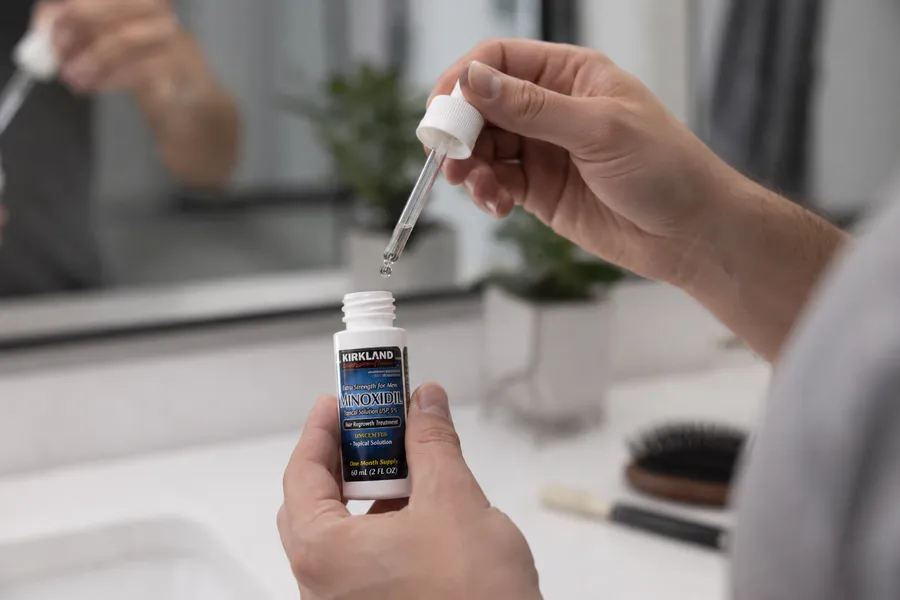
No. Minoxidil is contraindicated during breastfeeding — it transfers into breast milk and its effects on infants have not been studied. Even after weaning, any use should be discussed with a dermatologist, because physiological postpartum telogen effluvium generally does not warrant minoxidil: it resolves on its own.
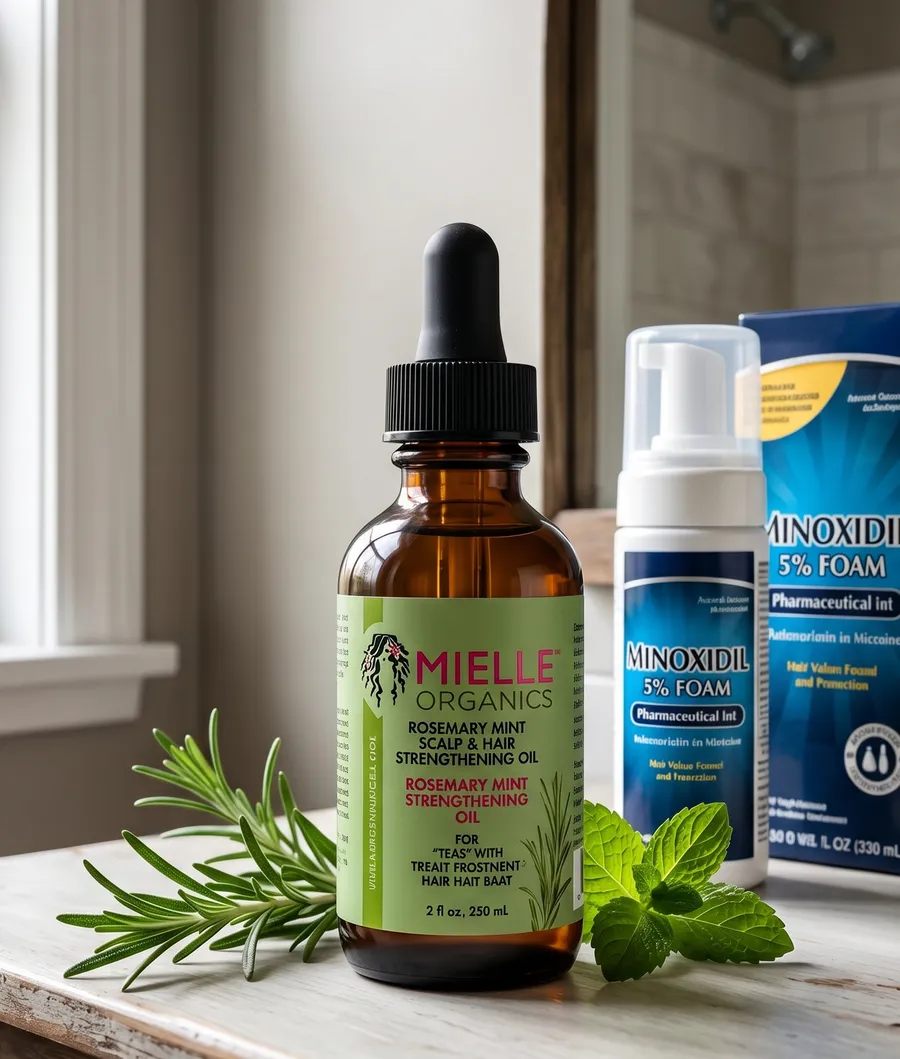
Minoxidil becomes relevant only if shedding persists beyond 12 months after ruling out iron deficiency and thyroid dysfunction, or if a dermatologist confirms underlying female androgenetic alopecia. It is not a first-line treatment for hormonal postpartum shedding. For gentle topical options in the meantime, rosemary oil has shown documented follicular stimulation effects without contraindication concerns.
Will my hair ever go back to exactly how it was before pregnancy?
In the vast majority of cases, yes — provided the cause is purely the hormonal telogen effluvium. Hair density typically returns to baseline between 12 and 18 months postpartum. The most reassuring sign: baby hairs growing back evenly across the entire scalp.
There is one important nuance. If female androgenetic alopecia (FAGA) was subclinically present before pregnancy — without you necessarily knowing it — the high estrogens of pregnancy may have temporarily masked it. The postpartum crash can then “unmask” that genetic tendency. In this case, the crown stays diffusely thin after 12 months even as the temples fill back in, and a dermatological consultation with video-dermoscopy can definitively distinguish between the two diagnoses.
Sources and Clinical Studies
-
Headington JT. — Telogen effluvium: new concepts and review, Arch Dermatol, 1993; 129(3): 356–363. PubMed
-
Lynfield YL. — Effect of pregnancy on the human hair cycle, J Invest Dermatol, 1960; 35: 323–327. PubMed
-
Kantor J, Kessler LJ, Brooks DG, Cotsarelis G. — Decreased serum ferritin is associated with alopecia in women, J Invest Dermatol, 2003; 121(5): 985–988. PubMed
Medically reviewed by our internal dermatology expert board. This article is informational and does not replace medical advice. If in doubt, consult your doctor or a board-certified dermatologist.