Medically reviewed by our internal trichology expert board.
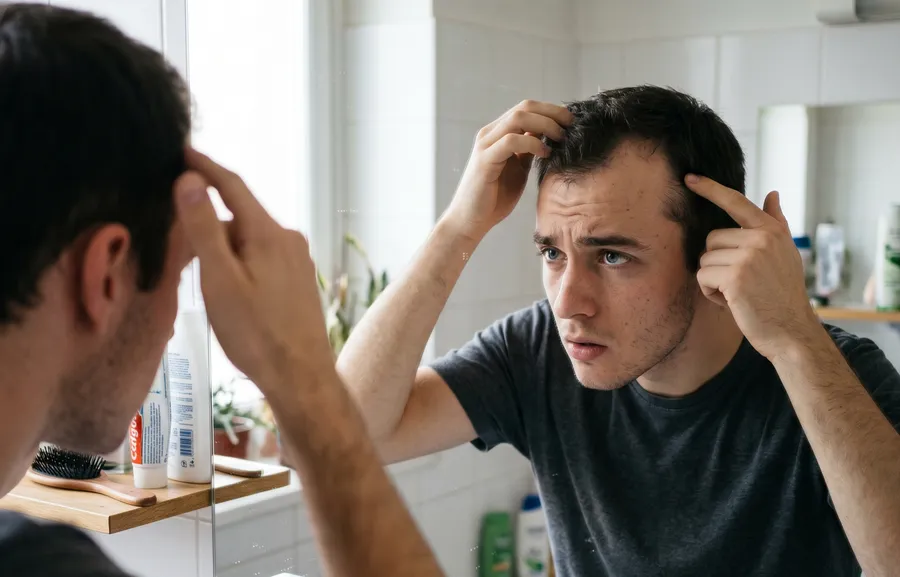
It happens in the shower. A Tuesday morning. Nothing special.
You look at your fingers. And there it is.
Too much hair. Way too much.
Or maybe it was in a photo from Saturday night — a group shot taken slightly from above, with flash. You zoomed in. You closed the app. You opened it again.
The question that follows is the same for every guy in that moment: “Am I actually going bald at 20?”
Honest answer: maybe. But not necessarily. And most importantly — if you are, you’re at exactly the right time to do something about it. Right now, at this age, treatments work at their absolute best.
Here’s how to read the signals, tell real baldness from unjustified panic, and what smart guys do in the first weeks after they notice.
The 5 Real Signs of Early Baldness
Hair loss is frightening. Even more so at 20 — in college, early in your career — when your hair is part of how you see yourself.
But here’s what most articles won’t tell you: losing 80 to 120 hairs a day is completely normal. In autumn, that number can climb to 200 without anything being wrong. What matters isn’t the shower drain. It’s these five signals.
1. Asymmetric temporal recession
A slight, symmetric recession on both sides between 18 and 22? That’s often a mature hairline — a physiological phenomenon that affects nearly all adult men. What’s concerning is asymmetric recession — more pronounced on one side, with a zone that gradually thins over several months.
2. Visible miniaturization at the vertex
Lean under bright light and look at the top of your scalp in a mirror. If the hairs at the vertex (crown) are visibly finer, shorter, and lighter than those at the temples — that’s follicular miniaturization. It’s the most reliable sign of androgenetic alopecia.
3. Density changes in photos
Compare a photo from six months ago with one from this week — same angle, same light. If you see a clear difference, your brain isn’t playing tricks. Slow progression is often more visible in photos than in the daily mirror.
4. Smaller and smaller root bulbs
Gently pluck 5 to 6 hairs from the affected area. Look at the roots under good light. A healthy bulb is white, round, and well-formed — like a tiny onion. A miniaturized bulb is tiny, barely visible, sometimes absent. If most of your plucked bulbs are small, that’s a signal.
5. Scalp visible under direct light
If a flash or overhead light reveals your scalp where it wasn’t visible before — your density has dropped. It’s not a matter of angle or flattering light.
Self-diagnosis · 3 questions
What is my risk level?
Question 1 / 3
How much hair do you find on your pillow in the morning?
💡 Evaluation algorithm validated by Thomas R., hair restoration specialist.
Mature Hairline or Real Baldness: The Decisive Difference
This is the question that ruins the sleep of many guys between 18 and 23.
A mature hairline is a natural, symmetric recession that stabilizes around ages 20–22. It affects roughly 96% of adult men to varying degrees. It doesn’t progress beyond that. It isn’t accompanied by miniaturization. You check it three months later and it’s exactly the same.
Early androgenetic alopecia, on the other hand, progresses. Slowly at first, then faster and faster if nothing is done. It follows the stages of the Norwood scale — and if you’re at Stage I–II at 20 with visible progression over 3 months, the problem is real.
The distinction rests on two criteria: progression over time and the presence of associated miniaturization. It’s not one or the other — it’s both together that make the difference.
💡 Expert Advice from Thomas R.: “I see 20-year-olds who come in convinced they need a hair transplant. The first thing I tell them: ‘Pull out your phone. Show me a photo from a year ago.’ In 40% of cases, the panic is unjustified — it’s a mature hairline that’s been stable for six months. In the other 60%, the progression is real. But in both cases, recommending a transplant at that age would be a mistake — I systematically refuse. The follicles are still alive and respond to treatment. Surgery is the last resort, not the first.”
The Pull Test: Your Home Diagnosis in Two Minutes
This test doesn’t replace a dermatology consultation, but it gives a serious indication you can run tonight.
How to do it:
- Don’t wash your hair for 48 hours before the test.
- Take a strand of 20 to 30 hairs between your thumb and index finger.
- Slide it between your fingers with gentle, steady pressure — from scalp to tips.
- Repeat three times on the left temporal zone, three times on the right, and three times on the vertex.
Reading the result:
- 0 to 2 hairs collected — Negative result. No sign of excessive active shedding.
- 3 to 5 hairs — Weakly positive. Monitor over four to six weeks.
- 6 hairs or more — Positive result. A dermatology consultation is warranted.
One important nuance: the test is less reliable in autumn (natural seasonal shedding) and in the weeks following a physical or emotional shock — illness, intense stress, sudden dietary change. If that applies, repeat it six weeks later.
Why 20 Is Precisely the Best Time to Act
It might seem counterintuitive. But starting young isn’t a curse — it’s a window of opportunity.
At 20, your hair follicles are still alive. DHT (dihydrotestosterone, the hormone responsible for androgenetic alopecia) hasn’t had time to miniaturize them completely. They’re still producing something — even if it’s finer than before. And it’s precisely on these weakened-but-alive follicles that treatments work.
A follicle that spends ten to fifteen years under DHT attack with no intervention eventually dies. Permanently. No treatment in the world — no transplant, no miracle serum — can resurrect a permanently atrophied follicle.
On the other hand, a miniaturized follicle at 20 can be stabilized, and sometimes even strengthened, through consistent early intervention.
That’s the difference between the guy who acts at 20 and the one who waits until 35. The first keeps his hair. The second is looking for a surgeon — often for a hair transplant in Turkey or Spain — after losing ten years of therapeutic window.
The First-Line Routine for Young Men
No transplant. No oral finasteride without a serious conversation with a dermatologist (the potential side effects deserve a real evaluation at this age). No miracle solution sold at inflated prices.
What works at 20 is a simple, consistent protocol based on documented mechanisms — the same ones covered in detail in our complete hair loss treatments guide.
Step 1 — Block Local DHT with a Ketoconazole Shampoo
DHT binds to the androgen receptors in your follicles and triggers their progressive miniaturization. First priority: reduce that exposure at the scalp level, without touching your overall hormonal balance.
A shampoo based on 2% ketoconazole, used two to three times a week on wet scalp (leave on for 3 minutes before rinsing), has demonstrated local anti-androgenic activity in several controlled studies. It’s available without a prescription, has no systemic effects, and is the foundation of any serious routine.
Nizoral Ketoconazole 2% Shampoo
Clinically studied formula · Local anti-androgen · 2-3x/week · No prescription needed
- Anti-DHT
- Ketoconazole 2%
- From first signs
$19.90
View on AmazonAffiliate link
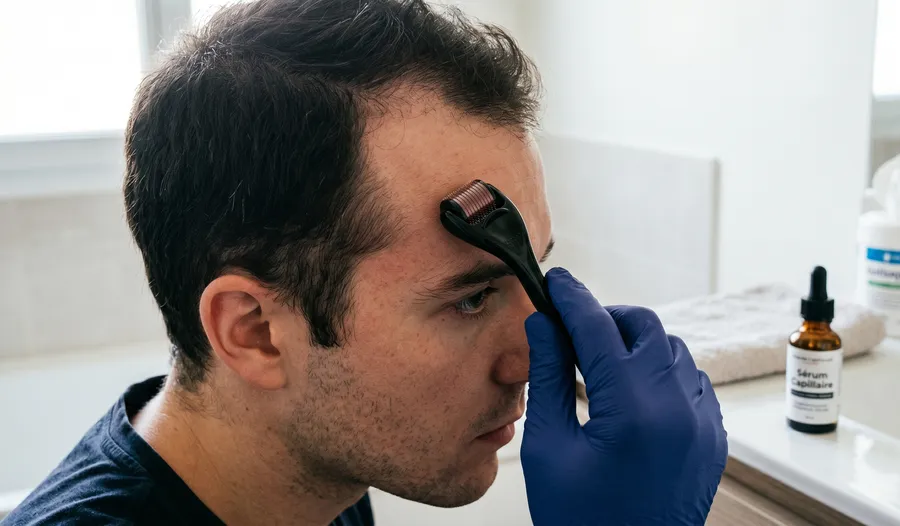
Step 2 — Reactivate Microcirculation with a Dermaroller
Scalp microneedling done correctly — one session per week, with a 0.5mm to 1.0mm dermaroller on a clean, dry scalp — stimulates the production of growth factors (VEGF, KGF) and significantly improves the penetration of topical actives applied afterward.
A 2013 study published in the Journal of Cutaneous and Aesthetic Surgery showed a 40% increase in hair density in patients treated with microneedling alone, compared to the control group — with no other associated treatment.
For beginners: start at 0.5mm, once a week. Wait four weeks to assess skin tolerance before moving to 1.0mm if you choose to.
Titanium Dermaroller 1.0mm · 540 Needles
Medical-grade titanium needles · Alcohol-sterilizable · 1 session/week · Minoxidil-compatible
- Titanium
- 1.0mm
- 2013 Study
$14.90
View on AmazonAffiliate link
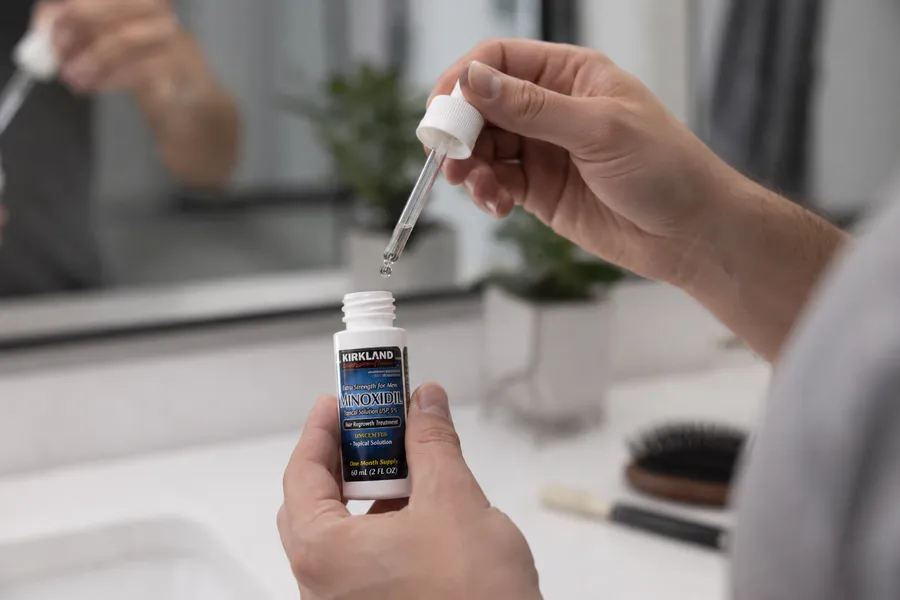
Step 3 — Topical Minoxidil 5%: The Gold Standard
Minoxidil remains the most documented molecule in the treatment of androgenetic alopecia. It extends the anagen phase of the hair cycle, increases the diameter of miniaturized follicles, and improves local vascularization.
At 20, with follicles still active, its effectiveness is at its peak. The rule: 1ml per day, applied directly to the dry scalp over affected areas. Not on the lengths. Let it dry for 4 hours before washing.
💡 Expert Advice from Thomas R.: “Minoxidil isn’t necessarily a lifelong treatment at 20 — it’s first and foremost a stabilization tool. I recommend starting it, evaluating the response over 6 months with reference photos, then deciding on a long-term strategy. Guys who start early and follow the protocol consistently get significantly better results than those who wait.”
Kirkland Minoxidil 5% · 60ml Lotion × 6
Reference topical formula · 1ml/day · Visible results at 3–6 months · Most studied molecule
- Minoxidil 5%
- Gold Standard
- 400+ Studies
$39.90
View on AmazonAffiliate link
Frequently Asked Questions
Is baldness at 20 permanent?
No — provided you act early. At 20, follicles are still mostly alive and responsive to treatment. Miniaturization can be slowed, stopped, and sometimes partially reversed. The word “permanent” only applies to dead follicles — and that mainly happens when nothing is done for many years.
My dad went bald at 40. Am I at the same risk?
Paternal heredity is a risk factor, but not a sentence. Androgenetic alopecia is polygenic — it involves dozens of genes transmitted from both sides of the family. Brothers in the same family can have very different hair outcomes. Chronic stress, nutrition, and sleep quality also modify how these genes express themselves.
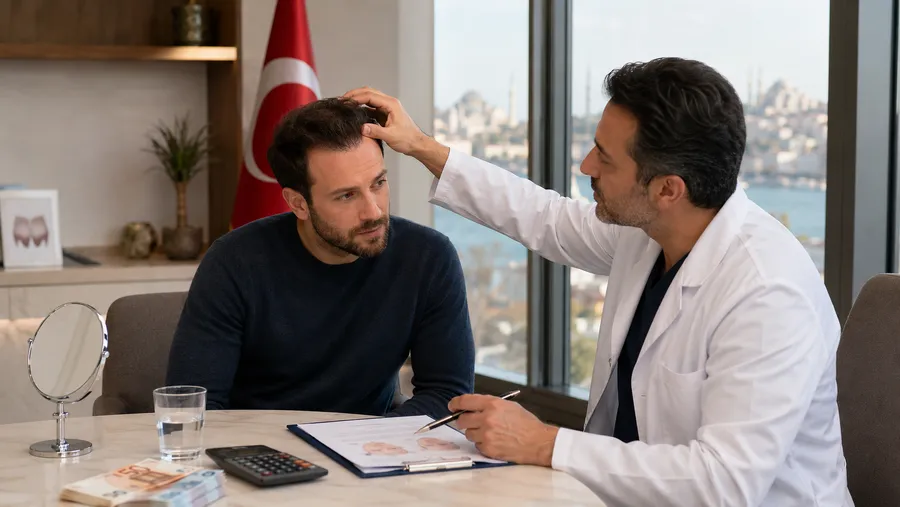
Should I see a dermatologist if I’m 20 and losing hair?
Yes — if the pull test is positive or if you observe visible progression over 3 months. A dermatologist can perform a trichogram or video dermoscopy — the only tools that objectively measure follicular density and miniaturization. The consultation also guides a blood panel (ferritin, TSH, zinc) to rule out reversible causes before concluding it’s androgenetic alopecia.
Sources and Clinical Studies
-
Sinclair R. — Male pattern baldness: a review and recommendations, Med J Aust, 1998. PubMed
-
Dhurat R. et al. — A Randomized Evaluator Blinded Study of Effect of Microneedling in Androgenetic Alopecia, J Cutan Aesthet Surg, 2013. PubMed
-
Olsen EA. et al. — A multicenter, randomized, placebo-controlled, double-blind clinical trial of a novel formulation of 5% minoxidil topical foam versus placebo in the treatment of androgenetic alopecia in men, J Am Acad Dermatol, 2007. PubMed
Medically reviewed by our internal trichology expert board.