Medically reviewed by our internal trichology expert board.
There’s something absurd about the way dermaroller advice spreads across hair loss forums.
Someone asks: “I want to treat my receding hairline — which size should I use?” The answer that keeps coming up: “1.5mm, it penetrates better.”
That’s wrong. And on your temples, it can be genuinely harmful.
Your hairline isn’t your crown. The skin there is thinner, the vascularization is different, and the tolerance for needles is significantly lower. What works on the vertex can cause bruising and micro-trauma on the temples.
This article is only about the hairline. Concrete mechanics, validated sizes, a step-by-step home protocol — and the mistakes that quietly destroy months of progress. If you’re still unsure whether your hair loss is genuine androgenetic alopecia or a temporary shed, start with our guide on the first signs of baldness before choosing a dermaroller.
Why temple skin is different
This is an anatomical reality that almost no mainstream article ever mentions.
Scalp skin isn’t uniform. At the vertex (crown), skin thickness typically ranges between 1.5 and 2mm. At the temporal zones — the hairline — it often drops to between 0.9 and 1.3mm. A difference that changes everything when you’re talking about needles.
A 1.5mm needle on the crown: dermal stimulation, growth factor production, VEGF activation. Documented.
That same 1.5mm needle on the temples: risk of reaching the temporalis muscle, excessive bleeding, counter-productive inflammation. Result: less regrowth, more tissue stress.
The hair follicles at your hairline are already weakened by DHT — the driver of male androgenetic alopecia. The goal of microneedling is to stimulate them — not compound the damage.
There’s also a follicular density issue. The temples tend to have a sparser distribution. Every single follicle counts. A poorly dosed trauma doesn’t just miss a zone — it impacts a follicle that may still have been viable.
One more factor: temple skin sits under slight permanent tension, pulled by facial muscle movement. This tension affects how micro-channels close after a session. Another reason to keep depth and pressure low.
The baseline rule for the hairline: 0.5mm. And before going any deeper, you need to have observed how your skin responds over at least four weeks.
Selector · 3 questions
Which dermaroller fits your situation ?
Question 1 / 3
Which area do you want to treat ?
💡 Hygiene protocol and sizes validated by Thomas R., hair restoration specialist.
Dermaroller or Derma Stamp? The right tool for your hairline
Most people know the dermaroller. Far fewer know the Derma Stamp exists.
The dermaroller rolls. As it rolls, it creates micro-channels at an oblique angle and generates a slight lateral drag on the skin. On the crown — a convex, even surface — that’s fine. On the hairline — an irregular zone with precise contours — that lateral drag becomes a drawback.
The Derma Stamp strikes vertically. Direct percussion, perpendicular to the skin. Result: straight micro-channels, no lateral drag, millimetre-level precision. You target exactly the zone you want to treat. Not a millimetre more.
For anyone treating only their hairline, the Derma Stamp has a real edge in precision and skin comfort.
Its only downside: it covers less surface per movement. A full session on both temples takes slightly longer than with a roller. That’s a fair trade.
Adjustable Derma Stamp · Vertical Percussion Head
Vertical strike · Zero lateral drag · Contour precision · Adjustable 0.25–1.0mm · Hairline-ready
- Vertical percussion
- Hairline precision
- Adjustable depth
$19.90
View on AmazonAffiliate link
Prefer to skip needles altogether? LLLT is the non-invasive alternative — our laser hair growth comb reviews cover the models with real clinical trial data behind them.
The home protocol, step by step
No magic. The protocol is straightforward. What separates results from nothing is consistency and discipline.
Preparing your session
Shampoo your hair as normal. Rinse thoroughly. Then dry completely — your scalp must be fully dry before using the dermaroller. Not slightly damp: dry.
Disinfect your tool. Not with water. Not with hand soap. With 70% isopropyl alcohol. Submerge the roller head (or stamp needles) for at least 60 seconds. Let it air-dry for 2 to 3 minutes before use.
The technique on the temples
Mentally divide each temple into three zones: front edge (hairline), middle, back edge toward the side of the head.
For each zone, pass the tool:
- 4 times horizontally
- 4 times vertically
- 4 times diagonally
- 4 times in the opposite diagonal
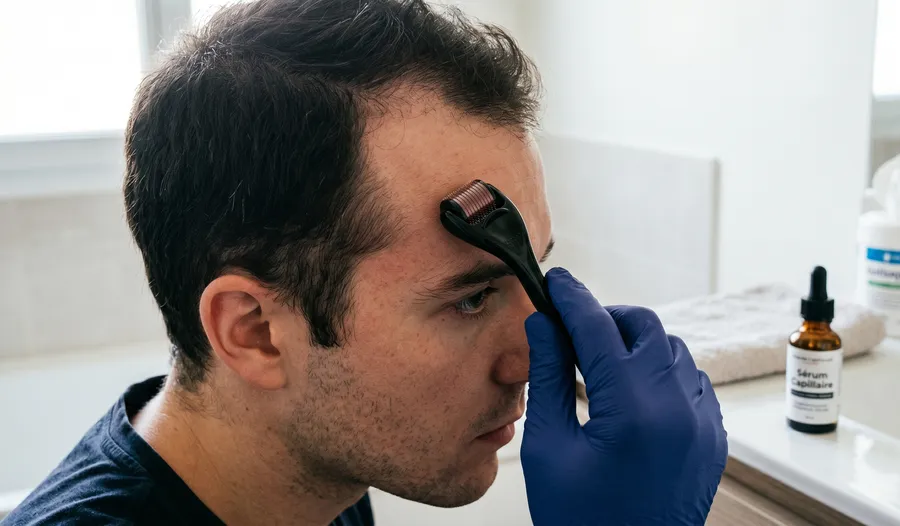
Pressure: light. You’re not trying to draw blood. Mild redness is normal. Faint red dots are acceptable. Bleeding is not a sign of efficacy — it’s a sign you pressed too hard.
Time per temple: 3 to 5 minutes maximum.
After the session
Apply nothing for the first 2 hours. No serum, no lotion, no minoxidil. The micro-channels are open.
If you’re using minoxidil, wait 24 hours. (We cover that in detail in the next section.)
Recommended frequency: once a week for a 0.5mm on the hairline. Your scalp needs 5 to 7 days to complete its healing cycle and produce the growth factors triggered by the repair process.
0.5mm Titanium Dermaroller · 540 Needles
Medical-grade titanium needles · Sterilisable with 70% IPA · 1 session/week · Safe on thin temple skin
- Titanium 0.5mm
- 540 needles
- Hairline & crown
$12.90
View on AmazonAffiliate link
Minoxidil + Dermaroller: the order that changes everything
This is the most-used combination — 5% minoxidil paired with the dermaroller. And the most misused.
Microneedling increases skin permeability. That’s precisely the point — it improves minoxidil penetration. But that heightened permeability doesn’t stop at a convenient moment if you apply the product right after your session.
When you use a dermaroller, you create micro-channels that take between 4 and 24 hours to fully close. Applying minoxidil within that window means skin absorption potentially 4 to 5 times higher than normal. On a small zone like the hairline, that’s manageable. On a larger area, systemic absorption becomes possible — with the side effects that come with it (low blood pressure, rapid heart rate).
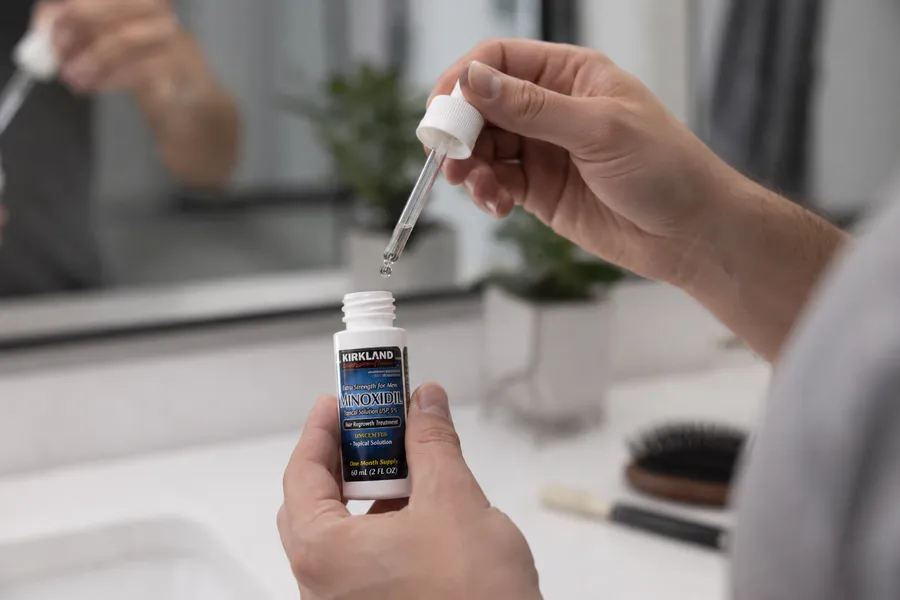
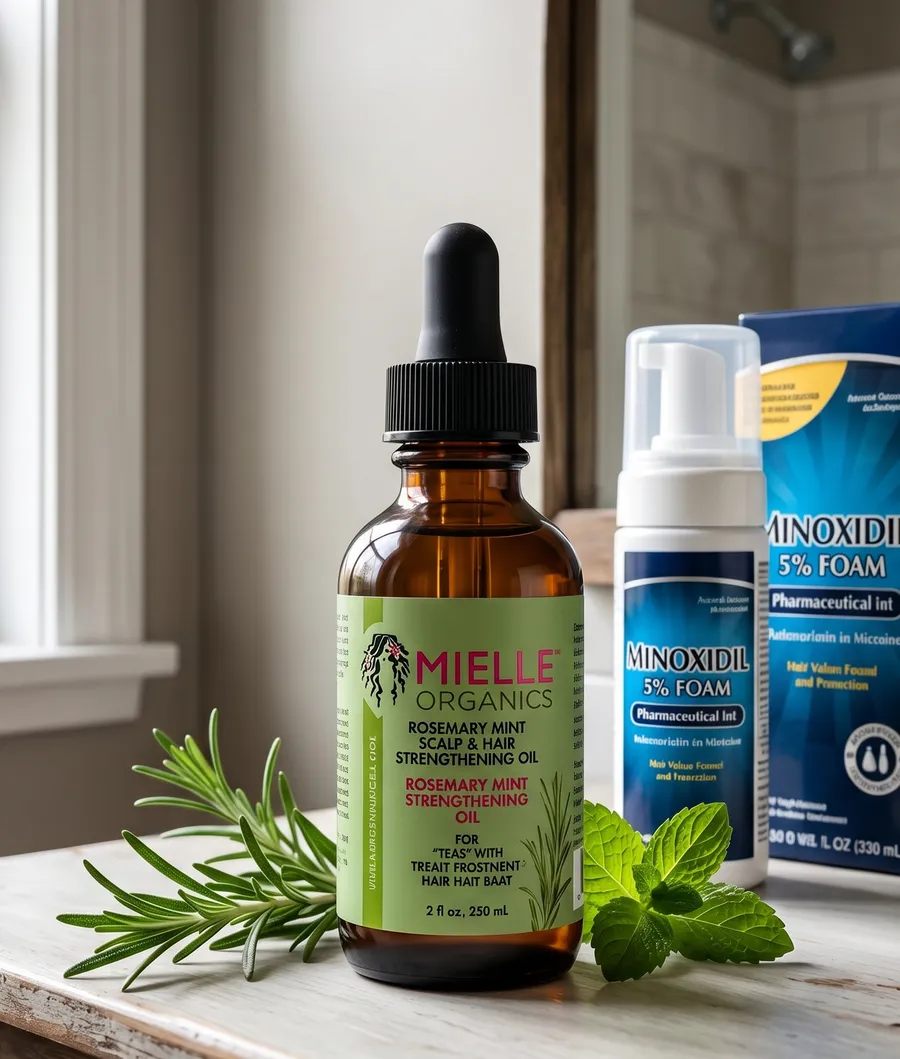
The rule is simple and non-negotiable: wait at least 24 hours between your dermaroller session and applying minoxidil. On rest days, rosemary oil is a natural topical that can maintain follicular stimulation without disrupting the scalp.
The correct weekly sequence:
- Day 1 — dermaroller session, nothing on the scalp for 2 hours, then normal routine without minoxidil
- Day 2 — resume minoxidil as normal
- Days 3 to 7 — minoxidil following your usual protocol
- Day 8 — new dermaroller session
💡 Thomas R.’s take: “The 24-hour rule isn’t a comfort measure — it’s real protection. I’ve seen guys apply their minoxidil straight after a session ‘to maximise the effect’. Result: persistent redness, chronic scalp irritation, and in one case, a hypotensive episode. Minoxidil works perfectly well without forcing the dosage. Respect the 24 hours.”
Tool hygiene is the other non-negotiable. 70% isopropyl alcohol is the standard. Household alcohol at 90% is too aggressive for titanium needles — it can weaken them over time. 70% is the right balance between bactericidal effect and needle preservation.
70% Isopropyl Alcohol · Dermaroller Sterilisation
Medical sterilisation standard · Preserves titanium needles · 60-second soak is enough · 500ml
- IPA 70%
- Medical grade
- Titanium-safe
$5.90
View on AmazonAffiliate link
The mistakes Thomas R. can’t stand seeing anymore
These are the mistakes I see every week in comments and DMs. Every single one is avoidable.
💡 Thomas R.’s take: “A dermaroller is a simplified medical tool for home use. Not a toy. Not something you use ‘at full force’ because you think more intensity equals better results. There are five behaviours I see far too often — and they destroy weeks of progress in a single session.”
Mistake 1 — A needle that’s too long for the temples
The 1.5mm is the forum favourite. On the crown, with proper technique, it can make sense. On the hairline? Absolutely not. You risk going too deep into thin skin with already-compromised follicles. The 0.5mm does the job. Moving beyond 0.5mm on the temples requires a genuine reason — not just the urge to go further.
Mistake 2 — Pressing hard to deliberately bleed
There’s a persistent myth that bleeding is a sign of efficacy. It’s false. Blood means vascular trauma, not follicular stimulation. The growth factors you’re after (VEGF, KGF) are produced by the healing mechanism triggered by light micro-injuries — not by wounds that bleed.
Mistake 3 — Rinsing the roller with water and calling that sterilisation
Hot water sterilises nothing. Neither does bathroom soap. If you’re not soaking your needles in 70% isopropyl alcohol, you’re reopening your scalp with a contaminated tool. Scalp infections after dermarolling exist — and they come from exactly this.
Mistake 4 — Sharing your dermaroller
Every body has its own skin flora and potential pathogens. A dermaroller that punctures skin is not a shareable accessory. Ever. Not even with your partner.
Mistake 5 — Using the dermaroller every day
“I do it twice a week because I read that more frequency means better results.”
No. The entire logic of microneedling relies on healing. If you re-stimulate before the previous session has fully healed, you’re not adding stimulation — you’re creating chronic inflammation. And chronic inflammation is the exact opposite of what you’re trying to achieve. Once a week. No more.
FAQ: Your Questions About Dermarolling for Hair Loss
Do you need to bleed for the dermaroller to work on your hairline?
No — and this is one of the most damaging myths in the microneedling space.
Blood is not an efficacy marker. It’s an overreach marker. The growth factors you’re trying to activate (VEGF, KGF, PDGF) are produced during the healing phase of light micro-injuries — not during haemorrhagic wounds. A scalp that bleeds regularly develops chronic inflammation. Chronic inflammation is the exact opposite of what you’re after. Mild redness at the end of a session: that’s the goal. Blood running: you pressed too hard or used too long a needle.
Can you apply Minoxidil immediately after a dermaroller session?
No — and it can be genuinely dangerous. Right after a session, the micro-channels are open. Skin permeability is multiplied 4 to 5 times. Applying minoxidil in that window means a massive, uncontrolled dose hitting your bloodstream. Systemic minoxidil can cause hypotension, rapid heart rate, and dizziness. On the hairline alone, the treated surface is small and the risk remains contained — but the 24-hour rule is a non-negotiable minimum, not a suggestion. Wait. The protocol will be more effective for it — and safer.
Does dermarolling pull out and damage healthy hair?
No, with correct technique. As the roller passes, a few hairs in the telogen phase — the ones that were going to fall out in the next few days anyway — may detach. This isn’t pathological hair loss: it’s natural shedding slightly accelerated. That said, a roller with blunted needles or used with too much pressure can create real mechanical friction on the hair shaft. A titanium roller used weekly needs replacing every 3 to 4 months. Not after six months. Not “when it seems worn”. Every 3 to 4 months, without exception.
Clinical Sources
-
Dhurat R. et al. — A Randomized Evaluator Blinded Study of Effect of Microneedling in Androgenetic Alopecia: A Pilot Study — J Cutan Aesthet Surg, 2013. PubMed
-
Fertig RM. et al. — Microneedling for the treatment of hair loss? — J Clin Aesthet Dermatol, 2018. PubMed
-
Doddaballapur S. — Microneedling with Dermaroller — J Cutan Aesthet Surg, 2009. PubMed
Scientifically validated by our trichology expert board.