Medically reviewed by our internal hair restoration expert board.
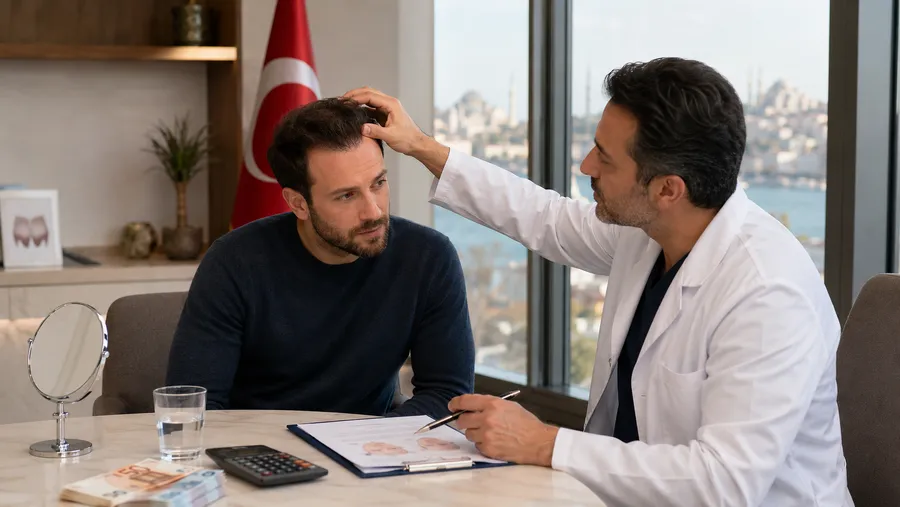
Why Pay €4,000 in Spain When Istanbul Does It for €1,500?
That’s the question everyone asks. It’s a fair question. You’d be naive not to ask it — you’d be dangerously naive to stop there.
Turkey became the global capital of budget hair transplants for a reason: the volume is real, some clinics produce genuinely decent results, and the prices look impossible to argue with. Istanbul alone has more hair transplant clinics per square kilometre than any other city on earth. The industry has built an entire tourism infrastructure around it — airport pickups, hotel packages, WhatsApp coordinators who respond at 2 a.m.
But here’s what the medical tourism industry buries under polished before-and-after galleries: a large proportion of these facilities are hair mills. Assembly-line operations optimised to process the maximum number of heads per day. Surgeons who show up to draw a hairline, hand things off to unlicensed technicians, and move on to the next room. Extraction rates so aggressive that patients — who paid €1,500 — are spending €6,000 in Spain to surgically repair the damage two years later.
Spain is not automatically better. There are poor-quality clinics in Madrid and Barcelona. The difference is the regulatory floor — the minimum standard below which a clinic simply cannot legally operate:
- The surgeon must be a certified dermatologist or plastic surgeon under EU law, with a documented specialisation in hair restoration. No exemptions.
- The facility is subject to Health Ministry inspections by the relevant Autonomous Community.
- If something goes wrong, you have the full legal infrastructure of the European Union behind you — Spanish civil courts, the Colegio de Médicos, medical negligence liability. Try pursuing a clinic in Istanbul from overseas.
- Post-op follow-up is logistically viable. A two-hour flight, not a twelve-hour journey with a bandaged scalp.
The Spain premium isn’t comfort. It’s risk management on a permanent, irreversible procedure. You are not paying for a nicer waiting room. You are paying for a surgeon who will be present at every critical step, a donor area that won’t be stripped bare, and a legal safety net if results fall short of what was promised.
Because here’s the number that matters most: a hair transplant cannot be undone. Every follicle extracted is gone permanently. Every canal incised at the wrong angle is wrong permanently. Getting this wrong to save €2,500 can cost you your entire follicular capital — the one resource that cannot be replaced or regrown.
The Truth About DHI (Choi Implanter Pen) vs Sapphire FUE
You’ve seen the ads. “DHI — zero scarring, hyper-natural results, revolutionary recovery.” And on the other side: “Sapphire FUE — the gold standard chosen by leading surgeons.” So which one do you pick?
Neither answer tells you what you actually need to know.
Here is the technical reality that marketing clinics don’t want you to understand: DHI and Sapphire FUE are not different extraction techniques. They are different implantation techniques.
In both cases, the extraction of follicular grafts from your donor zone is identical: a rotary micro-punch removes follicles one by one from the occipital and temporal areas. That extraction phase accounts for roughly 70% of your final result quality — and it is precisely where hair mills cut corners by sending non-medical technicians to do extractions while the junior doctor bounces between operating rooms.
After extraction, the methods diverge:
- Sapphire FUE: The surgeon first opens the recipient channels in the scalp using an ultra-thin sapphire blade (more precise than standard steel instruments, with cleaner micro-incisions that cause less tissue micro-trauma). Technicians then implant the sorted grafts into those prepared channels.
- DHI (Choi Implanter Pen): A spring-loaded pen-style device makes the incision and implants the graft in a single simultaneous motion. Slightly less time with the graft outside the body, marginally better theoretical survival rate for small-area densification work.
💡 Thomas R.’s Warning: “Stop asking me ‘DHI or Sapphire FUE.’ It’s the wrong question entirely. Ask me instead: does the surgeon personally perform all the recipient channel incisions, or does he delegate that step to his team? Because a mediocre surgeon with a Choi pen will produce a catastrophic result, and an exceptional surgeon with a standard blade will produce a masterpiece. The tool is 5% of the outcome. The person holding the tool is 95%.”
DHI has one legitimate advantage: it reduces the ischaemia time — the window during which extracted grafts sit outside the body before being placed. This marginally improves survival rates for patients with fragile follicles, or for targeted hairline densification where precision placement matters most. It is not a miracle technique. A properly stored graft in chilled saline solution during a Sapphire FUE procedure achieves comparable survival rates.
The variables that actually determine your result in ten years: transplantation density per cm², the naturalness of the hairline angle and directionality (a hair doesn’t grow straight up — it has a 30–45° inclination that varies by zone), and above all, the conservation strategy for your donor zone. Those are the questions worth asking.
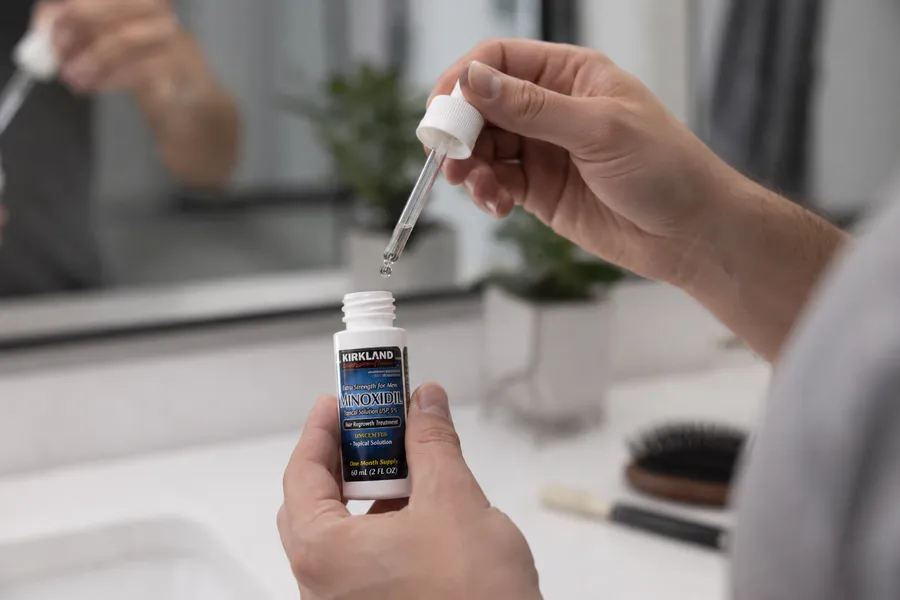
If you’re still in the medical treatment phase before considering surgery, our guide on Minoxidil 5% protocol and results explains how to stabilise hair loss before any surgical decision is worth making. A transplant performed on actively progressing loss is a transplant that will be outpaced.
Anti-Scam Checklist: Is Your Clinic a Hair Mill?
Before you book a consultation or send a deposit, run this tool. Check every promise the clinic made you during that initial contact.
Evaluation Tool · Anti-Scam
The Hair Mill Red Flag Checklist
Check every promise the clinic made you. The more boxes you check, the more concerned you should be.
💡 Medical evaluation criteria validated by Thomas R.
The 4 Criteria of a Top-Tier Clinic in Spain
Now you know what to avoid. Here is what to demand — not in vague marketing language, but as concrete, verifiable commitments you get before signing anything.
Criterion 1 — The Surgeon Performs All Recipient Channel Incisions Personally
This is the non-negotiable absolute. The recipient channel incisions determine the direction, depth, and density of your transplanted hair. An angle miscalculated by 5 degrees produces hair growing against its natural grain. Incorrect channel depth causes graft necrosis, pluggy “doll-hair” clusters, or absent growth.
These are surgical judgment calls. They require a surgeon, not a technician.
At your pre-operative consultation, ask this question directly and watch for the answer: “Will you personally perform all the recipient channel incisions throughout my procedure, or does your team handle that step?” If the response is evasive — “Our team is highly experienced”, “We have robust protocols in place” — translate that as: no, the surgeon won’t be doing it. Leave.
Criterion 2 — Conservative, Documented Donor Area Management
Your donor zone — the occipital and temporal areas of permanent follicles — is a non-renewable resource. Every follicle extracted is extracted permanently. A serious clinic will always perform a pre-operative follicular density mapping using digital trichoscopy: how many follicular units per cm², what is the distribution uniformity, where is the safe extraction boundary beyond which permanent donor area alopecia begins.
In practical terms, the average adult patient can donate between 4,000 and 7,000 total grafts across their entire surgical lifetime, all sessions combined. Any clinic that promises 5,000 grafts in a single session, without a prior density mapping, may be depleting your entire lifetime reserve in one sitting — leaving you with nothing to correct an unsatisfactory result, and nothing to address future hair loss progression.
💡 Thomas R.’s Warning: “I’ve reviewed case files from 32-year-old patients whose donor zones were completely stripped by a single clinic visit in Turkey. These men have zero surgical options remaining. Their hair loss will progress — because it wasn’t stabilised at the time of surgery — and there is nothing they can do about it. Their only option is a hairpiece. This is a silent medical catastrophe that the medical tourism industry buries under heavily curated result photos.”
Criterion 3 — Graft Processing Under Magnification
Once extracted, follicular grafts are critically fragile. Their viability outside the body is limited to a few hours under the best conditions — chilled saline, minimal handling, no direct light exposure. They degrade rapidly from dehydration, repeated manipulation, or careless handling by untrained hands.
Top-tier Spanish clinics maintain a dedicated graft processing station equipped with a stereoscopic microscope or binocular loupe. This allows the team to:
- Sort grafts by follicular unit size (1-hair, 2-hair, 3-hair units) so that single-follicle grafts go into the hairline for natural softness, and multi-follicle units go into the mid-scalp for density.
- Identify and discard damaged follicles rather than implanting them and wasting recipient channels.
- Store grafts in appropriate isotonic conservation solution at 4°C throughout the entire procedure.
If the clinic processes grafts on a dry gauze pad under overhead fluorescent light, with naked-eye sorting — you are in a production facility, not a medical clinic.
Criterion 4 — A Thorough Medical Consultation, Not a Quick Quote
An ethical surgeon turns patients away. That is not a weakness — that is the definition of competent medicine.
Surgical candidates must present stabilised hair loss, verifiable by trichoscopic monitoring over a minimum 12-month period. If you are in your mid-twenties and your hairline is still receding each quarter, the medically correct recommendation is: wait. Come back in two years.
This is exactly why we strongly recommend reading our guide on early signs of baldness in your 20s before considering surgery: getting a hair transplant at 20 is almost always a medical mistake, regardless of the clinic’s reputation. Hair loss at that age is rarely stabilised, and the transplanted grafts — which are genetically DHT-resistant by virtue of their occipital origin — will within a few years form isolated islands of transplanted hair surrounded by progressively expanding bald zones. You’ll need a second surgery, then a third.
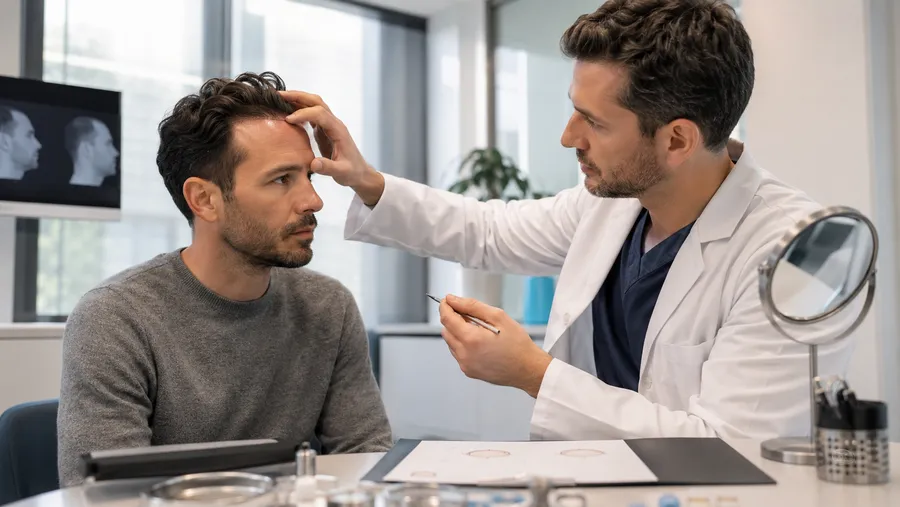
A proper pre-operative consultation includes: digital trichoscopy, Norwood classification with progression modelling, a realistic discussion of medical alternatives (Minoxidil, Finasteride based on your profile), and an honest estimate of available grafts and required grafts — with a margin kept in reserve for future sessions.
Post-Op Recovery: The Phase Everyone Underestimates
Surgery takes one day. Recovery takes weeks — and this is where a significant part of your result is actually determined.
The first ten days are critical. Your grafts are resting on your scalp, held in place only by a micro-fibrin clot. They have no blood supply of their own yet. They can be physically dislodged by:
- Friction against the pillow during sleep
- Direct water pressure from a normal shower head
- An unconscious scratch during a half-asleep itch
- Sleeping flat — which compresses the recipient zone and increases oedema
Sleeping at a 45° angle for the first five nights is not optional. It is a physiological requirement that most patients dramatically underestimate. Maintaining a conscious sleep position for seven hours is nearly impossible. A memory foam neck support pillow solves this without requiring conscious vigilance.
Memory Foam Travel Neck Pillow
Keeping your head at 45° for the first five nights is non-negotiable for graft survival. This memory foam pillow holds the correct position automatically throughout deep sleep, with no pressure on the recipient zone.
- Holds the 45° angle automatically during sleep
- Zero friction against transplanted grafts
- Breathable memory foam — no overheating
~$25.00
View on AmazonAffiliate link
The first wash typically takes place on Day 3 post-op (J+3), following your surgeon’s specific protocol. This is the most anxiety-inducing step. The scabs (crusts) covering your grafts look fragile — they are. The technique must be extremely gentle: lukewarm water poured gently over the area, never a direct jet, never any rubbing or scrubbing motion. A pH-balanced shampoo (5.5), free of sulphates, silicones, and aggressive foaming agents is essential. Standard baby shampoo works in a pinch, but a formula specifically designed for sensitive post-surgical scalp offers better assurance of proper healing.
Ultra-Gentle Baby Shampoo (pH 5.5)
The Day 3 wash is the highest-risk routine step post-surgery. An aggressive shampoo can prematurely detach scabs and physically pull out grafts that haven't yet vascularised.
- pH 5.5 — optimal for post-surgical healing
- Sulphate-free and non-irritating formula
- Supports the natural scab-shedding process
~$12.00
View on AmazonAffiliate link
Between washes, itching can become intense — a sign that follicles are actively healing, but a dangerous temptation to scratch. The clinically validated solution: a thermal spring water spray applied at a 15–20 cm distance from the scalp. Never pat dry. Let it evaporate naturally. Use every 2–3 hours during the first few days to keep the scalp moist and reduce the urge to touch.
Soothing Thermal Spring Water Spray
Calms itching without any contact with the grafts. Spray from 15–20 cm away, never wipe. The mineral content of thermal water supports scalp barrier recovery.
- Soothes itching without touching grafts
- Apply safely from a distance
- Mineral-rich formula supports healing
~$8.00
View on AmazonAffiliate link
For long-term density maximisation, many surgeons recommend gradually reintroducing Minoxidil 5% between months 3 and 6 post-surgery. The goal is not to protect the transplanted grafts — those are DHT-resistant by virtue of their occipital origin and will hold regardless. The goal is to protect your remaining native follicles, which are still vulnerable to androgenetic alopecia progression. Leaving them unprotected means watching the hair around your transplanted zone continue to thin in the years ahead.
FAQ & Pricing
What does a DHI hair transplant cost in Spain in 2026?
Pricing varies primarily by graft count and surgeon seniority. The ranges below reflect ethical, non-assembly-line clinics — not budget mills operating on volume turnover:
| Grafts | Spain (ethical clinic) | Turkey (reputable clinic) |
|---|---|---|
| 1,500 grafts | €2,800 – €4,000 | €1,200 – €2,000 |
| 2,500 grafts | €4,000 – €6,000 | €1,500 – €2,500 |
| 3,500 grafts | €5,500 – €8,500 | €2,000 – €3,500 |
Price red flag: Be wary of any Spanish clinic quoting below €1.20 per graft. Below that threshold it is mathematically impossible to sustain a qualified surgical team, proper equipment, adequate operating time, and any meaningful post-operative follow-up.
Is a DHI hair transplant painful?
The procedure is performed under local anaesthesia. The anaesthetic injection phase (15–30 minutes at the start of the session) is the most uncomfortable part — patients typically describe intense pressure and sharp stinging. Once the anaesthesia takes effect, the procedure is painless.
The evening of surgery and the following 2–3 days bring tension headaches and a sensation of tightness across the scalp, often accompanied by forehead oedema that can track down toward the eyes. Standard analgesics (paracetamol, ibuprofen as prescribed) are sufficient in most cases.
When can I return to sports after a hair transplant?
- Light walking: from Day 3, avoiding excessive sweating.
- Moderate cardio (stationary cycling, brisk walking): not before Day 30.
- Intense exercise (weightlifting, contact sports, pool swimming): not before Day 45–60.
Heavy sweating creates a bacterial environment on the scalp that increases folliculitis risk and can dislodge grafts that haven’t fully vascularised. There is no shortcut here — your entire scalp situation for the next decade depends on these first weeks.
When do I see the final result?
The shock loss phase occurs between months 1 and 3: transplanted grafts shed before re-entering the growth cycle. This is completely normal physiological behaviour — it does not indicate graft failure, though it is psychologically brutal for most patients.
First permanent hairs emerge between months 4–6. Density increases progressively and the full result should be assessed at 12–18 months post-procedure. Never evaluate a transplant before the 12-month mark.
Can I get a transplant if my hair loss is still progressing?
No. The medically correct answer is a hard no. As we detail in our guide on early signs of baldness in your 20s, transplanting onto active, progressive hair loss is building on unstable ground. Your native follicles around the transplanted zone will continue to miniaturise and fall, creating — within 3 to 5 years — isolated “islands” of DHT-resistant transplanted hair surrounded by expanding bald zones.
Clinical standard of care: no surgery before age 30 (barring exceptional cases with documented trichoscopic stability over 24 consecutive months), and verified loss stabilisation before any intervention is scheduled.
Does DHI leave visible scarring?
In FUE-based techniques (including Sapphire FUE and DHI), donor zone scarring consists of micro-dot white marks of 0.7–0.9 mm diameter, scattered across the occipital and temporal zones. Invisible to the naked eye at any hair length above 1 cm. Undetectable with any standard haircut.
The recipient zone leaves no visible scarring — micro-incisions close completely within weeks.
Clinical Sources
-
ISHRS — International Society of Hair Restoration Surgery: Practice Census 2023 — Annual report on surgical techniques, procedure volumes by country, surgeon training standards and documented complication rates. ishrs.org
-
European Academy of Dermatology and Venereology (EADV): Guidelines on Androgenetic Alopecia and Hair Restoration Surgery (2024 update) — European clinical framework for surgical candidacy assessment, anaesthetic protocols, and post-operative care recommendations.
-
Bernstein RM, Rassman WR. — “Follicular Transplantation: Patient Evaluation and Surgical Planning”, Dermatologic Surgery, vol. 23, n°9, 1997 — Foundational study on donor zone management, maximum safe extraction densities, and surgical candidate selection criteria.