Medically reviewed by our in-house trichology committee.
Twenty people, three months
For hair, black seed oil rests on one published trial. Twenty people, ten of them treated, three months, back in 2013 — and the product used was a low-dose scalp lotion, not the bottle of neat oil sold for hair today.
That trial studied diffuse shedding, the kind that follows a trigger and often resolves on its own. Nobody has tested black seed oil on pattern baldness at all. Meanwhile, this particular oil carries something most of the shelf does not: three published reports of skin reactions, one of them systemic and serious.
None of that makes it a product to throw out. It makes it a product whose marketing has traveled much further than its evidence, and the gap is worth seeing before you spend six months on it.
The one trial, read line by line
The study comes from a dermatology team in Rome and describes itself, in its own title, as a pilot. That word matters: a pilot exists to decide whether a real trial is worth running. Thirteen years on, that real trial has not appeared.
The design is genuinely decent for its size. Randomized, double-blind, placebo-controlled. Twenty patients with telogen effluvium, split into two arms of ten; one arm applied a lotion containing Nigella sativa daily for three months, the other a placebo. The authors report significant improvement in 70% of the treated patients, together with a measured increase in hair density and hair thickness on videodermoscopy, and they conclude the plant “can be considered potentially useful” for that condition.
Ten people treated. That is the entire hair file for this plant.
I spell it out because “studies have shown” — plural — is what you will read on nearly every bottle. There are no studies. There is a pilot, and a cautiously worded one.
The second thing hidden behind the 70% matters more than the number itself: telogen effluvium frequently recovers without treatment. An uncontrolled version of this study would have proved nothing at all, which is precisely why the placebo arm is to its credit. Ten people per arm, though, is small enough that chance remains a comfortable explanation for a difference of this kind.
The bottle is not the product that was tested
Here is the detail that made me write this piece, and it appears on no label.
The 2013 lotion was dosed at 0.5% black seed, according to the reviews that cite it. The bottle you buy for your hair is neat oil. Run the division and you get two hundred times the concentration of the only thing that was ever measured.
That gap does not argue in either direction. Neat oil is not “two hundred times better” — with topicals, concentration and effect are almost never proportional — and it is not automatically more dangerous either. The point is that nobody has compared them, so there is nothing to read on the bottle. You are buying the raw material the tested product was made from, not the tested product.
The diagram below puts all five forms this plant is sold in on one axis, and marks the one rung that carries a measurement.
Interactive diagram
Five products carry the name. One of them was tested on hair
Tap a rung to see what was measured on it, and what never was.
Five products, one measurement. Pick a rung above.
What the diagram shows
The rung that was tested is not the one that sells. The 2013 trial used a low-dose lotion on ten people with diffuse shedding; the bottle on the shelf is the neat oil, and nobody has compared the two. That is not an argument that the bottle works less well. It is an observation: on the bottle, there is nothing to read.
The correction
If what you want is a botanical topical whose file contains a randomized trial run against an actual drug, that is not black seed. It is rosemary. The full file, limits included, is in our rosemary oil review.
Affiliate link
Check the label for Rosmarinus officinalis, the 1,8-cineole content, and remember an essential oil goes into a carrier — never neat on the scalp.
To be fair about what that division means: plenty of cosmetics sell with no trial behind them at all, and that is not a scandal. What bothers me here is the sales argument specifically — a bottle of neat oil marketed on the strength of a trial that used something else.
Does it make sense for you?
Whether this oil is worth your money depends less on the oil than on what you actually have. Shedding that started in September, a hairline that has been retreating for six years, and a scalp that has been flaking since winter are three different questions — and on one of them, this oil is specifically a bad idea.
Selector · 3 questions
Does black seed oil make sense for you?
Question 1 of 3
What brought you here?
💡 Reading grid built by Thomas R., hair restoration specialist, from the sources listed at the end of this article. It points you somewhere; it does not diagnose. A skin reaction, or shedding that speeds up, belongs in front of a doctor.
On pattern baldness, there is nothing to read
If you came here about a receding hairline or a thinning crown, the useful finding is an absence.
No published trial has tested black seed oil on androgenetic alopecia, in any form — oil, lotion or capsule. Two bodies of work let you verify that absence rather than take my word for it.
The first is a 2022 systematic review and meta-analysis of randomized trials of Nigella sativa in dermatology. It identified fourteen records, covering atopic dermatitis, acne, psoriasis, vitiligo, cutaneous leishmaniasis, warts, eczema and arsenical keratosis, and pooled four of them, with an odds ratio of 4.59 (95% CI 2.02 to 10.39). So this plant does have a dermatology file. Hair loss is not in it.
The second is a 2025 review devoted specifically to herbal remedies for hair loss. The plants it reviews include rosemary, saw palmetto, onion juice, Korean red ginseng, pumpkin seed oil, azelaic acid, olive oil, coconut oil, henna, honey, rice bran extract, ashwagandha and amla. Black seed is not among them.
Read that absence correctly. It does not show the oil is useless — you cannot demonstrate the inefficacy of something nobody tested. It means that buying it for pattern loss is not betting on weak evidence; it is betting with no evidence. And on this pattern specifically, time is not neutral. A follicle that has been miniaturizing for years does not come back. The months are the real cost, not the twelve dollars.
Three published reactions
There is one area where black seed oil is better documented than most of this shelf, and it is not the one the marketing picks: contact dermatology.
Three papers, all in the same specialist journal, report reactions to it.
In 2002, a team in Frankfurt described allergic contact dermatitis caused by an ointment containing black seed oil. It is a one-page report, and it is the first of its kind.
In 2023, a French team published a severe case of what the literature calls connubial contact dermatitis: the person reacting was not the one applying the product, but the partner of a man using black seed oil in his beard cosmetics. That detail has a practical edge — a contact allergen does not stay on the head of whoever applies it.
Then, in 2022, something more serious. A 28-year-old woman with no allergy history applied black seed oil daily over her whole body, face included. A generalized rash appeared roughly a week later. The picture met the criteria for DRESS — a delayed reaction that combines skin involvement with blood abnormalities and can affect organs. Systemic corticosteroids were required, and full resolution took a month. Six months later, a patch test with her own oil came back positive while three control subjects tested negative.
Three published cases are not a frequency, and I am not going to inflate them into one. Millions of people use this oil without incident. What the cases establish is narrower and sufficient: black seed oil is a documented contact sensitizer, not a neutral substance by virtue of being botanical. Memorial Sloan Kettering’s herb monograph puts it plainly enough — topical use of the pure oil has caused allergic reactions.
That is why the selector above rules one profile out without hedging: eczema, a known contact allergy, skin that reacts easily. On that ground, what you might gain does not cover what you are risking.
What a label is allowed to claim
A fair question follows from all this: if the evidence is that thin, how does a bottle get to say “supports thicker, fuller hair”?
Because in the United States, the line that matters is not how strong the evidence is — it is what the product claims to be. A cosmetic is intended to cleanse or beautify. A product intended to treat disease, or to affect the structure or function of the body, is a drug by definition, regardless of what it is made of. Hair growth sits squarely on the structure-and-function side: the FDA has treated claims like “stimulates hair growth” or “combats hair loss” on cosmetic products as drug claims, and has sent warning letters on exactly that basis.
What that produces on the shelf is a vocabulary built to stay inside the cosmetic lane. “Nourishes,” “strengthens,” “supports healthy-looking hair,” “reduces the appearance of thinning.” None of those promise a follicle will restart, so none of them require the evidence such a promise would need. And an oil that coats the shaft and reduces mechanical breakage does have a real, measurable effect — it is simply a different effect from the one you are shopping for.
So the reflex is a single question: is the label talking about the hair, or the follicle? Shaft language describes something already dead and out of the skin. Follicle language describes biology, and that is where a cosmetic stops being a cosmetic. It is the same dividing line laid out in our comparison of aminexil and minoxidil, where one is a cosmetic and the other a regulated drug — with all the difference in evidence that follows.
European readers get at the same place by another route: there, cosmetic claims must meet six common criteria, including evidential support held in the product file before the claim is made.
If you use it anyway
Plenty of people will read the above and keep the bottle. That is a defensible choice — an oil can be worth having for reasons other than regrowth.
A few reading habits, then. None of them is a dose, and none replaces advice from someone who knows your file.
One ingredient if you can manage it. A “hair treatment” where black seed sits eighth on a list of twelve teaches you nothing: ingredient lists run in descending order of quantity, and whatever happens next, good or bad, will not be attributable to anything.
Test a small patch of skin before the first real application, given the three cases above. For a substance the literature describes as a sensitizer, that is the floor.
No overnight oil soak under a cap, and nothing applied to a scalp that is already red, flaking or sore. When the complaint is the scalp itself rather than the density, a different file opens — the one about ketoconazole shampoo and inflammatory causes, which gets settled before anything is added on top.
Two situations belong to a professional rather than an article. First, any long-term prescription: the Memorial Sloan Kettering monograph notes that black seed inhibits CYP2D6 and CYP3A4, two enzymes that metabolize a large share of drugs, with clinical relevance unknown; it also notes possible liver injury at high doses and a lack of human data. Second, pregnancy and breastfeeding, where the usual rule holds — nothing new gets added without asking.
And whatever you decide, set an honest clock. Dated photographs, same framing, same light, six months of patience. The method, and why a single hair count proves nothing, is in our piece on how many hairs a day is normal to lose.
What actually carries a file
An article that concludes “there is almost nothing to read” owes you somewhere else to look. The shelf is not empty, just extremely uneven.
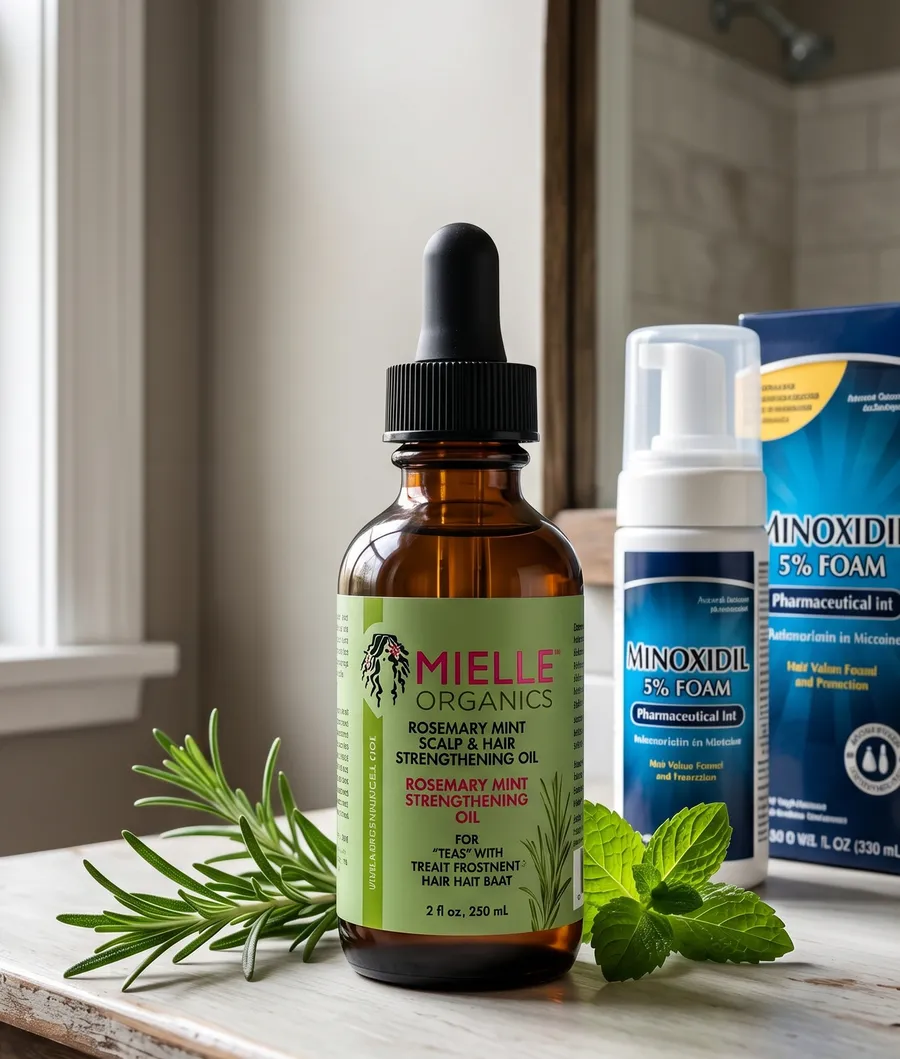
Among botanicals, rosemary goes furthest: it is the only one on this shelf to have been compared against a minoxidil lotion in a randomized trial over six months. That is not a settled case, and we take its limits apart in our Mielle rosemary oil review — but it sits a full grade above the rest of the botanical aisle.
Behind it, saw palmetto and pumpkin seed oil each have a small file with real design flaws. The first is in does saw palmetto work for hair loss; the second in reading the famous 40%, where the capsule tested held six ingredients. Biotin mostly deserves to be understood for what it distorts in your blood work.
If what you have is established pattern loss, the things that change the trajectory are drugs rather than oils — with side effects, contraindications, and for one of them a mandatory prescription and an absolute contraindication in pregnancy. Both files are open here: the 5% minoxidil protocol for men and finasteride, what the evidence actually shows. Neither one gets started on the strength of an article.
And if your shedding is diffuse and recent — the exact profile of the 2013 trial — no product is the priority. Finding the cause is: iron, thyroid, childbirth, a restrictive diet, a fever, a new medication. The full approach is in our guide to chronic telogen effluvium. Most of those causes correct, and hair returns when they do.
Limits, and when to see a doctor
This article diagnoses nothing and replaces no examination. Androgenetic alopecia, telogen effluvium, alopecia areata and iron deficiency can look alike from a distance and are not managed the same way — which is exactly why no oil should be chosen before you know which one you have.
See a doctor rather than waiting on a possible effect if you have:
- sudden, heavy shedding, by the handful, or loss that is clearly accelerating;
- clean, well-defined bald patches, especially with eyebrows, eyelashes or nails involved;
- a scalp that is red, painful, scaly or thickened, or that has changed in character;
- shedding alongside unusual fatigue, weight change, cycle changes or shifts in mood;
- any reaction after applying a product: redness spreading past the treated area, facial swelling, fever, swollen glands or feeling unwell. In that case keep the bottle — it is what allows the culprit to be identified, by patch testing months later if needed.
On black seed oil itself, three limits hold together. Its hair file is one pilot trial in twenty people. The product sold is not the product tested. And it is a documented contact sensitizer. None of that makes it something nobody should use. All of it makes it a product whose claims run far ahead of what has been measured.
Frequently asked questions
Does black seed oil regrow hair? One trial measured it: twenty people with diffuse shedding, ten of them treated for three months with a low-dose lotion, in 2013. The authors report improvement in 70% of the treated group and a density gain on videodermoscopy, while calling their own work a pilot study. For pattern baldness, no published trial exists.
Should I use it neat or diluted? More open than it sounds, and that is the problem: the trial used as the sales argument employed a 0.5% lotion, not neat oil, and nobody has compared the two on hair. What is known is that the skin reactions reported in the literature involve neat oil or products containing it.
Does black seed block DHT the way finasteride does? You will see that comparison, built on laboratory and animal work. A mechanism seen in a dish or in a rodent is not a result in a person — the same trap runs the length of the supplement aisle, and we take it apart in our saw palmetto file. Finasteride has clinical trials behind it, along with documented side effects and a prescription requirement.
Can I take it as capsules for hair? The hair data concern a topical application, not an oral one. Swallowing it also raises questions a scalp application does not: the Memorial Sloan Kettering monograph flags CYP2D6 and CYP3A4 inhibition of unknown clinical relevance, possible liver injury at high doses, and missing human data. On any long-term prescription, that question goes to a pharmacist.
How long before I judge it? Six months, with dated photographs taken under matched conditions. Hair grows roughly a centimeter a month, and diffuse shedding takes months to turn around. Verdicts delivered at six weeks measure nothing but early optimism.
My scalp itches since I started. Is that it working? No. An oil that makes skin react is not an oil doing something useful — it is the signal to stop and have the scalp looked at, all the more so given the published sensitization cases. Keep the bottle to show.
Sources and references
- Rossi A, Priolo L, Iorio A, et al. — Evaluation of a Therapeutic Alternative for Telogen Effluvium: A Pilot Study. Journal of Cosmetics, Dermatological Sciences and Applications, 2013. DOI 10.4236/jcdsa.2013.33A1002. Randomized, double-blind, placebo-controlled pilot study. Twenty patients with telogen effluvium in two arms of ten; a lotion containing Nigella sativa against placebo, applied daily for three months. The authors report significant improvement in 70% of treated patients, a significant increase in hair density and thickness on videodermoscopy, and conclude that NS can be considered potentially useful in telogen effluvium. The 0.5% figure does not appear in the abstract: it is reported by reviews citing the trial, and is attributed as such in this article. The division comparing it with 100% neat oil is ours, not the study’s.
- Nasiri N, Ilaghi Nezhad M, Sharififar F, Khazaneha M, Najafzadeh MJ, Mohamadi N. — The Therapeutic Effects of Nigella sativa on Skin Disease: A Systematic Review and Meta-Analysis of Randomized Controlled Trials. Evidence-Based Complementary and Alternative Medicine, 2022;2022:7993579. DOI 10.1155/2022/7993579. Fourteen records identified, covering atopic dermatitis, acne, arsenical keratosis, psoriasis, vitiligo, acute cutaneous leishmaniasis, warts and eczema; four pooled in the meta-analysis, pooled odds ratio 4.59 (95% CI 2.02–10.39). No hair indication among the conditions studied.
- Ahmed A, Alali AM, Abdullah E, Alharbi MN, Alayoubi HM. — Herbal Remedies for Hair Loss: A Review of Efficacy and Safety. Skin Appendage Disorders, 2025;11(4):360–371. DOI 10.1159/000542876. PMID 40771449. Review of botanical remedies for hair loss; the plants covered include rosemary, saw palmetto, onion juice, Korean red ginseng, pumpkin seed oil, azelaic acid, olive oil, coconut oil, henna, honey, rice bran extract, ashwagandha and amla. The absence of Nigella sativa is noted from the plant and search-term list the review states; the full text was not reachable from this session.
- Zedlitz S, Kaufmann R, Boehncke WH. — Allergic contact dermatitis from black cumin (Nigella sativa) oil-containing ointment. Contact Dermatitis, 2002;46(3):188. PMID 12000337. DOI 10.1034/j.1600-0536.2002.460318.x. Short report from the dermatology department of Frankfurt University Medical School: allergic contact dermatitis caused by an ointment containing black cumin oil.
- Assier H, et al. — Severe allergic contact connubial dermatitis to Nigella sativa seed oil due to repeated contacts to beard cosmetics. Contact Dermatitis, 2023. PMID 36494318. DOI 10.1111/cod.14266. Severe allergic contact dermatitis from indirect, repeated exposure: the affected person is the partner of a man using beard cosmetics containing black seed oil.
- Fargeas C, et al. — Drug reaction with eosinophilia and systemic symptoms (DRESS) syndrome after topical use of Nigella sativa (black cumin) oil. Contact Dermatitis, 2022. DOI 10.1111/cod.14127. A 28-year-old woman with no prior allergy, applying black cumin oil daily over her entire body including the face. Generalized rash roughly one week after starting; Kardaun severity score of 5, consistent with DRESS. Systemic corticosteroid treatment, with complete regression of the exanthema within one month. Patch testing six months later with the patient’s own oil was positive, with three negative controls. The authors note only one prior reported case of DRESS following application of the oil.
- Memorial Sloan Kettering Cancer Center — About Herbs: Nigella sativa. Integrative medicine monograph. Points used: inhibition of CYP2D6 and CYP3A4, which may affect intracellular concentrations of drugs metabolized by those enzymes, with clinical relevance not established; allergic reactions reported after topical use of the pure oil; possible liver damage at high doses; insufficient human data. These monographs are updated — the online version governs.
- U.S. Federal Food, Drug, and Cosmetic Act, drug and cosmetic definitions, and FDA enforcement on hair-growth claims. Under the Act, an article intended to diagnose, cure, mitigate, treat or prevent disease, or intended to affect the structure or any function of the body, is a drug, and a single product can be both a cosmetic and a drug. The FDA has treated hair-growth and hair-loss claims on products marketed as cosmetics as drug claims, including in warning letters citing wording such as “stimulate hair growth” and “combat hair loss.” European readers: the equivalent framework is Article 20 of Regulation (EC) No 1223/2009 together with Regulation (EU) No 655/2013, which sets six common criteria for cosmetic claims — legal compliance, truthfulness, evidential support, honesty, fairness and informed decision-making — with the supporting evidence held in the product information file before the claim is made.
Sources above are cited by journal, year, volume, DOI and PubMed identifier where these exist. Direct access to PubMed, Europe PMC and publisher sites was blocked by this session’s network policy: each reference was therefore verified by cross-checking several independent searches, and anything drawn from a full text is reported at abstract level or stated qualitatively. No regrowth figure, responder percentage or timeline is advanced here beyond what the cited publications report themselves.